The broad muscles of the back
Two broad, flat muscles cover most of the back. The trapezius spreads over the neck and upper back, and the right and left muscles together form a large four-sided figure, the trapezium that gives the muscle its name. Below it the latissimus dorsi, the widest muscle of the back, covers the lower back and the side of the chest.
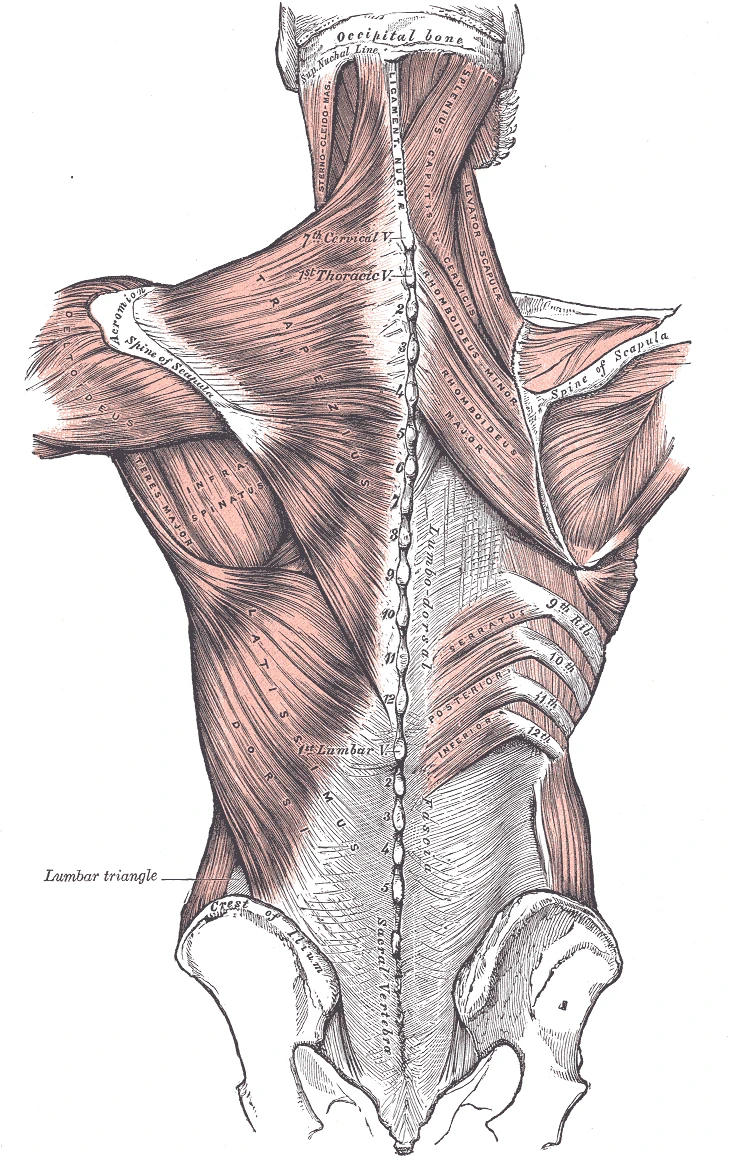 Muscles joining the arm to the spine, the trapezius and the latissimus dorsi on one side and the deeper rhomboids and levator scapulae on the other, Gray's Anatomy, 1918, figure 409Wikimedia Commons, Henry Vandyke Carter, Public domain (Gray409.png)
The latissimus dorsi starts on the spines of the lower six thoracic vertebrae, on the lumbar vertebrae and sacrum through the thoracolumbar fascia, and on the iliac crest. Its fibres narrow into a tendon only a few centimetres wide, which winds round the lower edge of the armpit to the front of the humerus.
It pulls the raised arm down and back and turns it inward, as in climbing, rowing, swimming and pull-ups. When the arms are fixed, as on crutches or on parallel bars, it lifts the trunk.
Sources
- Susan Standring (ed.), Gray's Anatomy, 42nd ed. (2020), chapters on the back and on the shoulder girdle and arm.
Prev: Three layersNext: Erector spinae