The buttock
The gluteus maximus is the heaviest muscle in the body and gives the buttock its shape. It starts on the back of the ilium, the sacrum and the coccyx, and runs down and out to the femur and to the iliotibial tract, a band of tendon down the outside of the thigh.
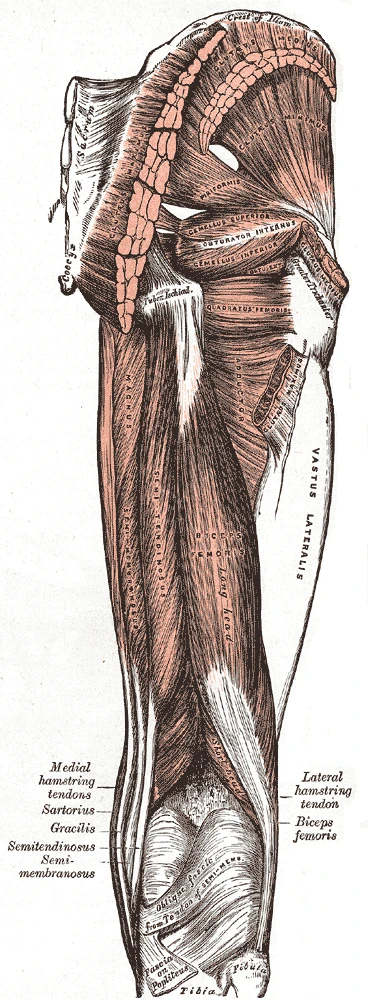 Muscles of the buttock and the back of the thigh, with the gluteus maximus and medius cut to show the deep muscles beneath, and the hamstrings below, Gray's Anatomy, 1918, figure 434Wikimedia Commons, Henry Vandyke Carter, Public domain (Gray434.png)
It straightens the hip with force in climbing stairs, running, jumping and rising from a chair, and does little in walking on level ground. Humans have a far larger gluteus maximus than apes, and the muscle works hardest in running.
The gluteus medius lies above and partly under it, on the outer side of the hip bone, and ends on the greater trochanter of the femur. In walking it holds the pelvis level each time the body stands on one leg. When it is weak, the pelvis drops on the side of the lifted leg.
Sources
- Susan Standring (ed.), Gray's Anatomy, 42nd ed. (2020), chapter on the pelvic girdle, gluteal region and thigh.
- Daniel Lieberman, David Raichlen, Herman Pontzer, Dennis Bramble and Elizabeth Cutright-Smith, The human gluteus maximus and its role in running, Journal of Experimental Biology 209 (2006): 2143-2155.
Prev: Into the handNext: Iliopsoas