The chest
The pectoralis major covers the front of the chest. Its upper part starts on the clavicle and its larger lower part on the sternum and the upper ribs. The fibres converge on a flat tendon that twists on itself before it inserts on the humerus, below the shoulder. It pulls the arm forward and across the chest and turns it inward.
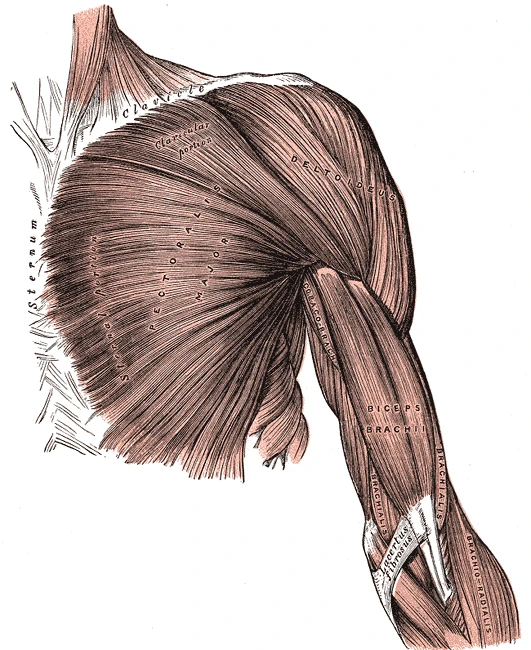 Superficial muscles of the chest and the front of the arm, with the pectoralis major, the deltoid and the biceps brachii, Gray's Anatomy, 1918, figure 410Wikimedia Commons, Henry Vandyke Carter, Public domain (Gray410.png)
The serratus anterior lies on the side of the chest. It starts in finger-like slips on the upper eight or nine ribs, which give it a saw-toothed edge, and passes behind the scapula to its inner border. It holds the scapula against the ribs and rotates it so that the arm can be raised above the head.
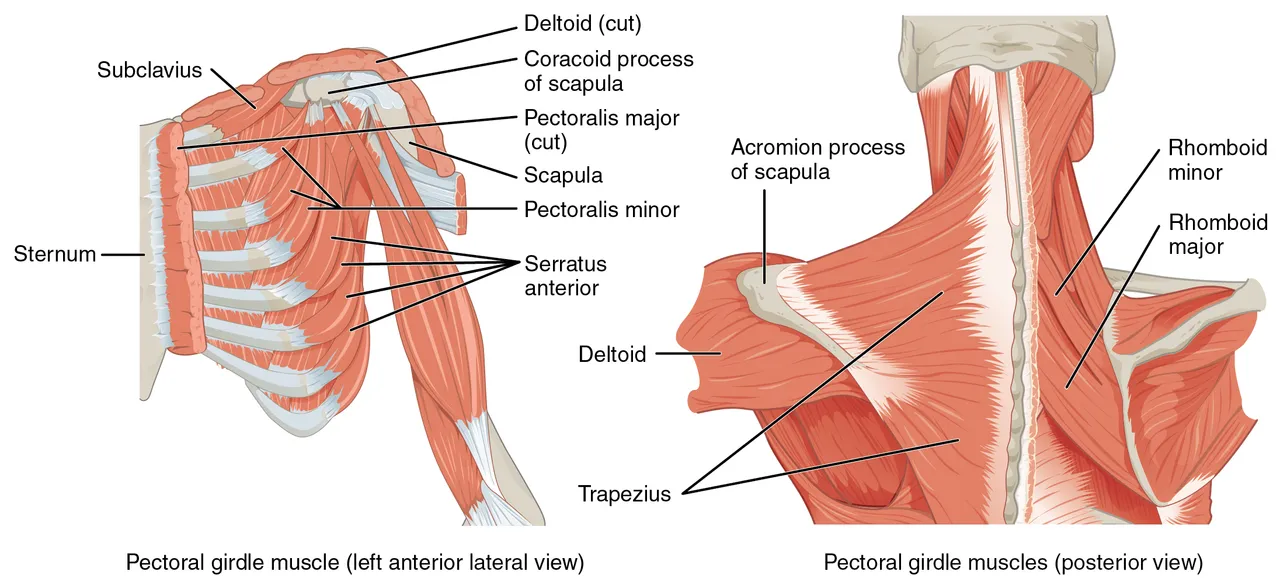 Muscles that hold and move the scapula, the pectoralis minor and the serratus anterior from the front and the trapezius and the rhomboids from behind, OpenStax Anatomy and PhysiologyWikimedia Commons, OpenStax, CC BY 4.0 (1118 Muscles that Position the Pectoral Girdle.jpg)
If its nerve, the long thoracic nerve, is damaged, the inner edge of the scapula lifts away from the chest when the person pushes against a wall. This is called a winged scapula.
Sources
- Susan Standring (ed.), Gray's Anatomy, 42nd ed. (2020), chapters on the chest wall and on the shoulder girdle and arm.
Prev: The neckNext: Breathing