Chewing
Four pairs of muscles move the lower jaw in chewing. The masseter runs from the cheekbone to the angle of the jaw and can be felt hardening when the teeth clench. The temporalis fans out over the side of the skull and narrows to a tendon on the jaw's coronoid process. Both close the mouth.
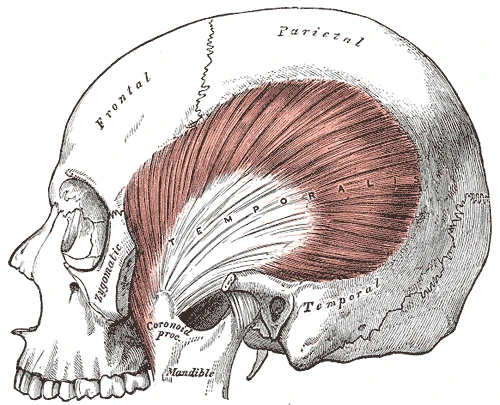 The temporalis fanning over the side of the skull to the coronoid process of the mandible, with the zygomatic arch and the masseter removed, Gray's Anatomy, 1918, figure 382Wikimedia Commons, Henry Vandyke Carter, Public domain (Gray382.png)
Two smaller pairs, the medial and lateral pterygoids, lie deep to the jaw. They pull it forward and from side to side, so that the molars grind the food. All four pairs are supplied by the mandibular branch of the trigeminal nerve.
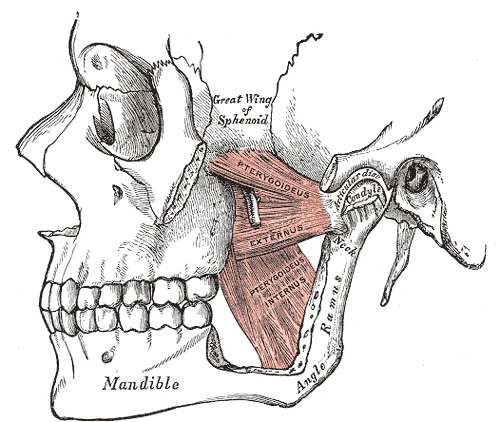 The lateral and medial pterygoid muscles inside the ramus of the mandible, with part of the ramus removed, Gray's Anatomy, 1918, figure 383Wikimedia Commons, Henry Vandyke Carter, Public domain (Gray383.png)
The jaw muscles can press the incisors together with a force of about 25 kilograms and the molars with about 90 kilograms.
Sources
- Susan Standring (ed.), Gray's Anatomy, 42nd ed. (2020), chapter on the infratemporal and pterygopalatine fossae and temporomandibular joint.
- Arthur Guyton and John Hall, Textbook of Medical Physiology, 13th ed. (2016), ch. 64.
Prev: The faceNext: The neck