Cross-bridges
When the biceps and the brachialis bend the elbow, their filaments keep their length and slide past each other. Heads that stick out from each myosin filament grab the actin beside them, tilt and pull it toward the middle of the sarcomere, let go and grab again. Each stroke moves the actin 5 to 10 nanometres.
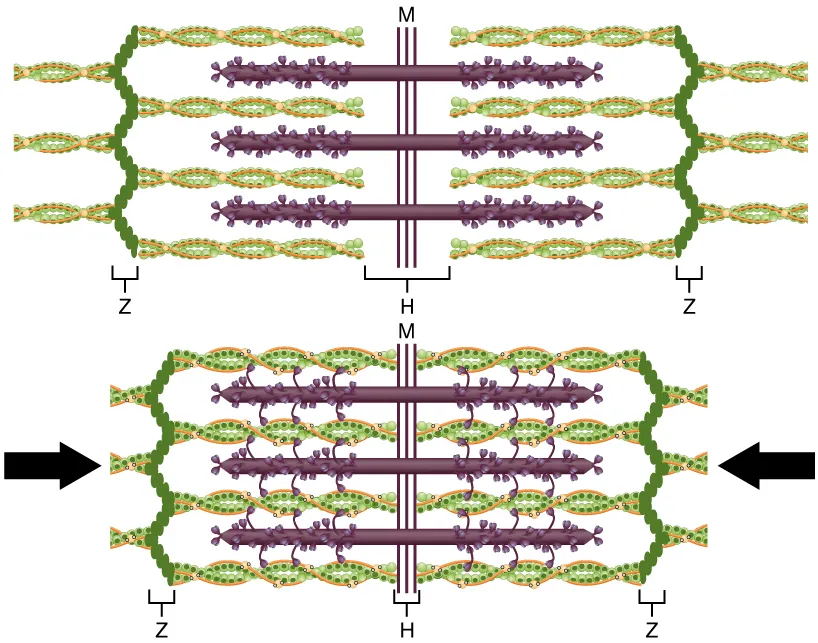 A sarcomere relaxed, above, and contracted, below, with the actin filaments slid over the myosin toward the middle and the Z discs drawn closer, OpenStax Anatomy and PhysiologyWikimedia Commons, OpenStax, CC BY 4.0 (1006 Sliding Filament Model of Muscle Contraction.jpg)
The signal to start is calcium. A nerve impulse spreads over the fibre and into it along fine tubes, and a store inside the fibre, the sarcoplasmic reticulum, releases calcium. Calcium moves aside troponin and tropomyosin, the proteins that cover the binding sites on actin. When the impulses stop, pumps take the calcium back and the muscle relaxes.
Every stroke uses one molecule of ATP, and the head needs ATP to let go of the actin. After death the ATP runs out, the heads stay attached and the muscles stiffen. This rigor mortis lasts until the muscle proteins break down, some 15 to 25 hours later.
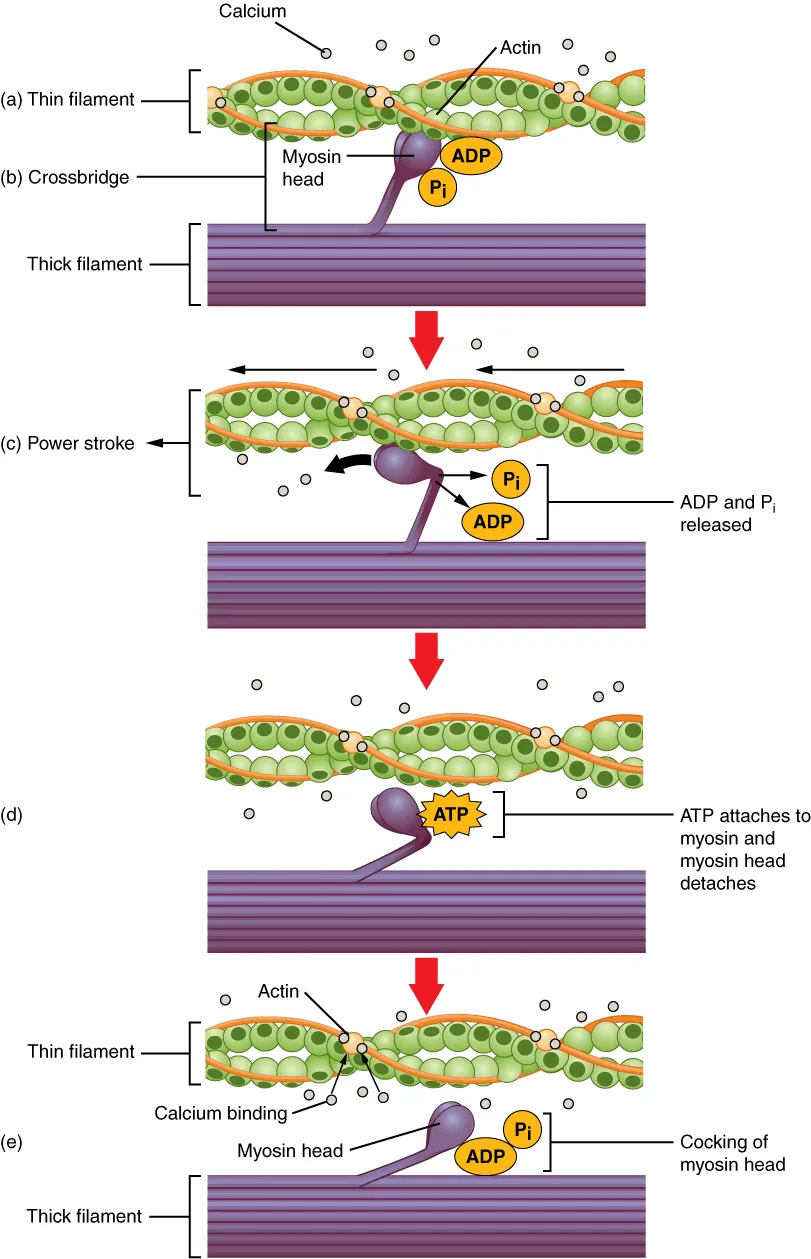 The cross-bridge cycle, in which a myosin head binds actin, pulls in the power stroke, lets go when ATP binds and is cocked again, OpenStax Anatomy and PhysiologyWikimedia Commons, OpenStax, CC BY 4.0 (1008 Skeletal Muscle Contraction.jpg)
Sources
- Arthur Guyton and John Hall, Textbook of Medical Physiology, 13th ed. (2016), ch. 6 and 7.
Prev: The sarcomereNext: The motor unit