The deltoid
The deltoid gives the shoulder its rounded shape. It is shaped like an upside-down Greek letter delta. It starts on the clavicle, the acromion and the spine of the scapula, along the same line where the trapezius ends, and narrows to a rough patch halfway down the outer side of the humerus.
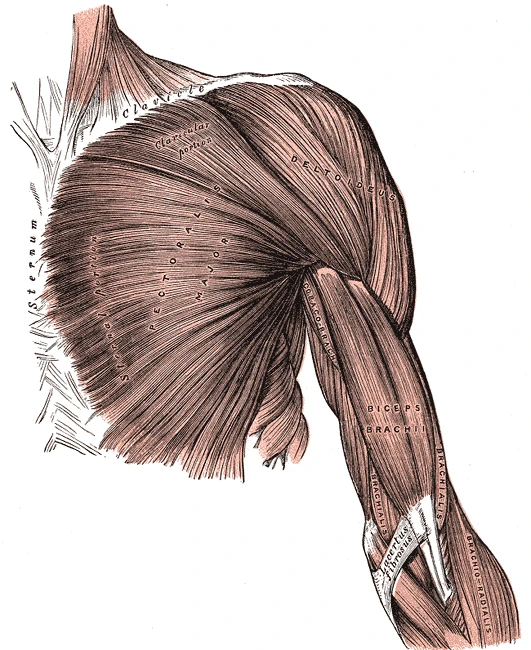 Superficial muscles of the chest and the front of the arm, with the pectoralis major, the deltoid and the biceps brachii, Gray's Anatomy, 1918, figure 410Wikimedia Commons, Henry Vandyke Carter, Public domain (Gray410.png)
Its three parts can work apart. The middle part raises the arm to the side, the front part lifts it forward and the back part draws it backward. The supraspinatus works with it, most of all at the start of raising the arm to the side.
The deltoid is supplied by the axillary nerve, which winds round the neck of the humerus. A dislocated shoulder or a broken humerus can stretch this nerve and weaken the deltoid. The thick upper part of the muscle is a common place for injections.
Sources
- Susan Standring (ed.), Gray's Anatomy, 42nd ed. (2020), chapter on the shoulder girdle and arm.
Prev: Erector spinaeNext: The rotator cuff