1862
Duchenne's faces
In the 1850s the French neurologist Guillaume Duchenne de Boulogne stimulated single muscles of the face with electric current through two electrodes on the skin. His main subject was an old shoemaker whose face had little feeling, so the current did not hurt him. Duchenne had the expressions photographed and published them in 1862 as Mécanisme de la physionomie humaine.
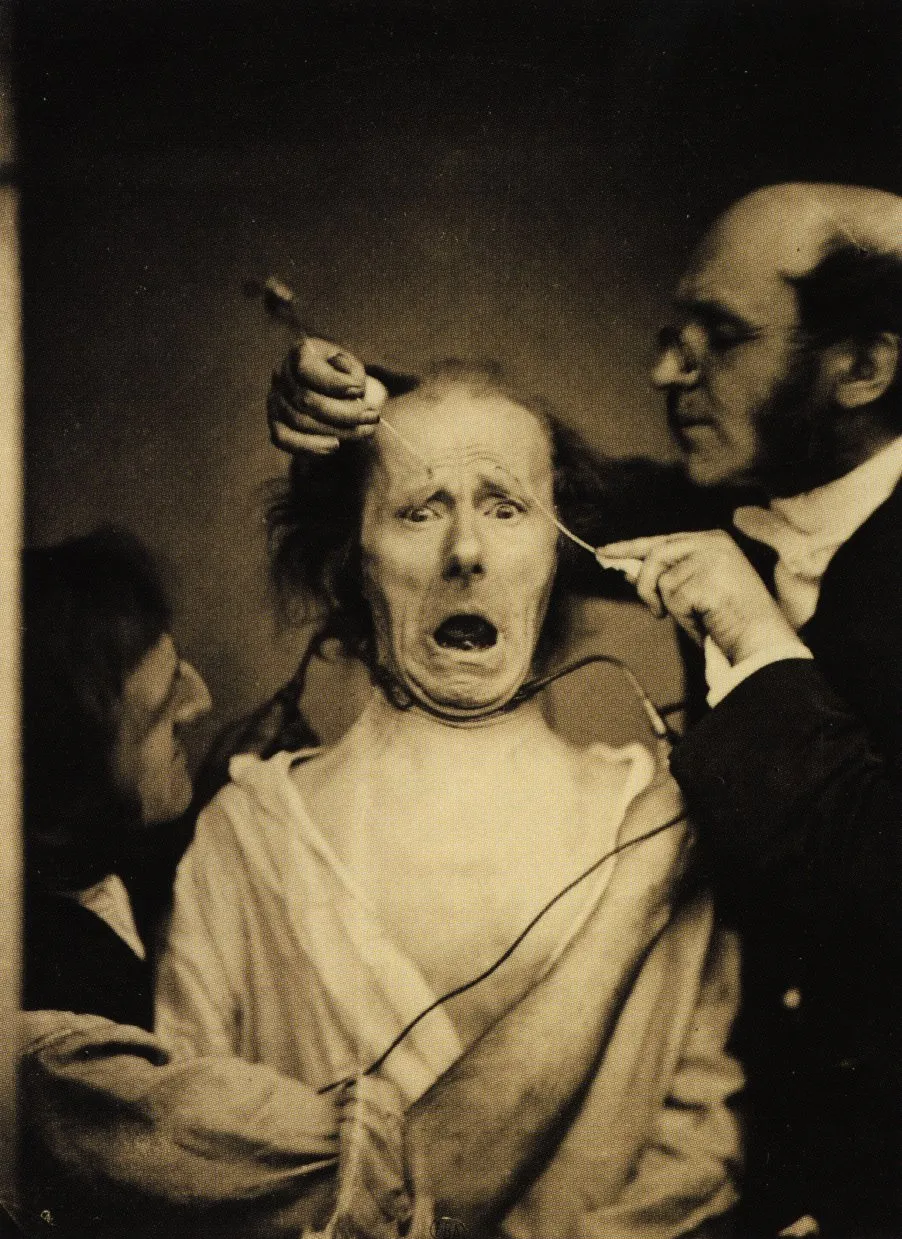 Duchenne holding electrodes to the face of his main subject, from Mécanisme de la physionomie humaine, 1862Wikimedia Commons, Guillaume Duchenne de Boulogne, Public domain (Guillaume Duchenne de Boulogne performing facial electrostimulus experiments.jpg)
He found that the zygomaticus major alone pulls the mouth into a smile that looks false. A smile of real joy also tightens the orbicularis oculi around the eye, which raises the cheek and creases the skin at the outer corner. Few people can tighten that part of the muscle at will. Psychologists now call the full smile the Duchenne smile.
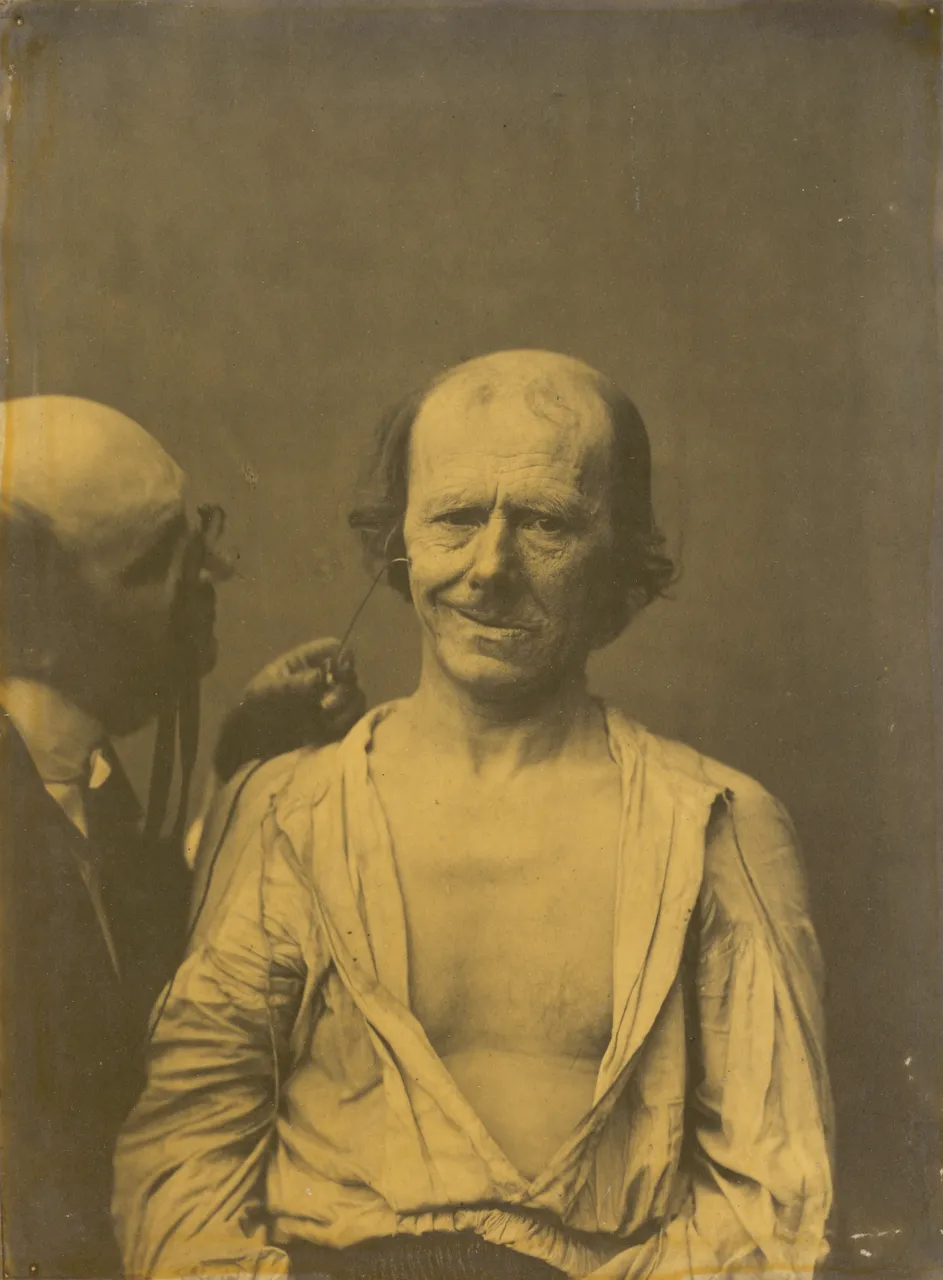 Duchenne's subject with current on one cheek, the zygomaticus major pulling the mouth into a smile that the eyes do not join, photographed between 1854 and 1856Wikimedia Commons, Guillaume Duchenne de Boulogne, National Gallery of Art, CC0 (Guillaume-Benjamin-Amant Duchenne (de Boulogne), A relaxed face (left); False joy or laughter (right), 1854-1856, NGA 169275.jpg)
Charles Darwin used several of Duchenne's photographs in The Expression of the Emotions in Man and Animals in 1872.
Sources
- Guillaume-Benjamin Duchenne de Boulogne, Mécanisme de la physionomie humaine (Paris: Renouard, 1862).
- Charles Darwin, The Expression of the Emotions in Man and Animals (London: John Murray, 1872).
- Paul Ekman, Richard Davidson and Wallace Friesen, The Duchenne smile, Journal of Personality and Social Psychology 58 (1990): 342-353.
Prev: Vesalius's muscle menNext: The sliding filaments