The face
The muscles of the face are thin sheets that start on bone and end in the skin, so when they contract they move the skin. There are about 20 on each side, all supplied by the facial nerve. They close the eyes and lips, help with speech and eating, and make the expressions people read on a face.
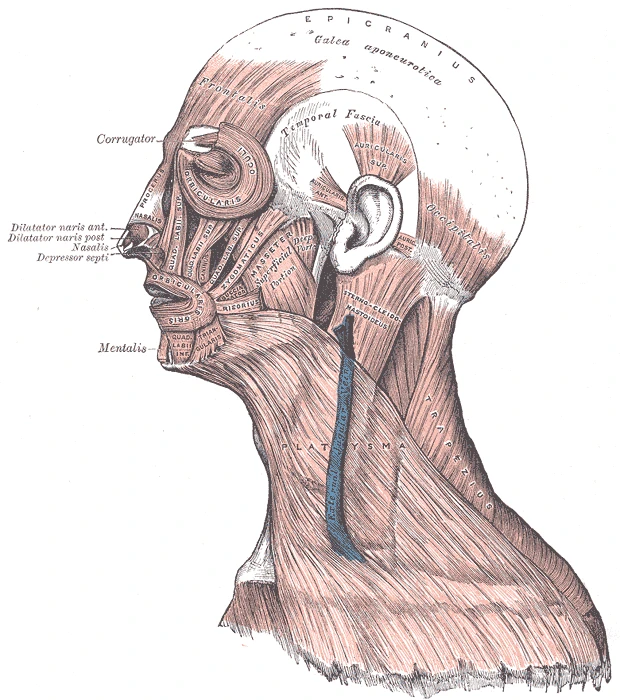 Muscles of the head, face and neck from the side, among them the frontalis, the orbicularis oculi and oris, the zygomaticus, the masseter and the platysma, Gray's Anatomy, 1918, figure 378Wikimedia Commons, Henry Vandyke Carter, Public domain (Gray378.png)
The orbicularis oculi is a ring around the eye that closes the lids, gently in a blink and tightly in a squint. The orbicularis oris rings the mouth and closes and purses the lips. The frontalis raises the eyebrows and wrinkles the forehead. The zygomaticus major pulls the corner of the mouth up and out in a smile.
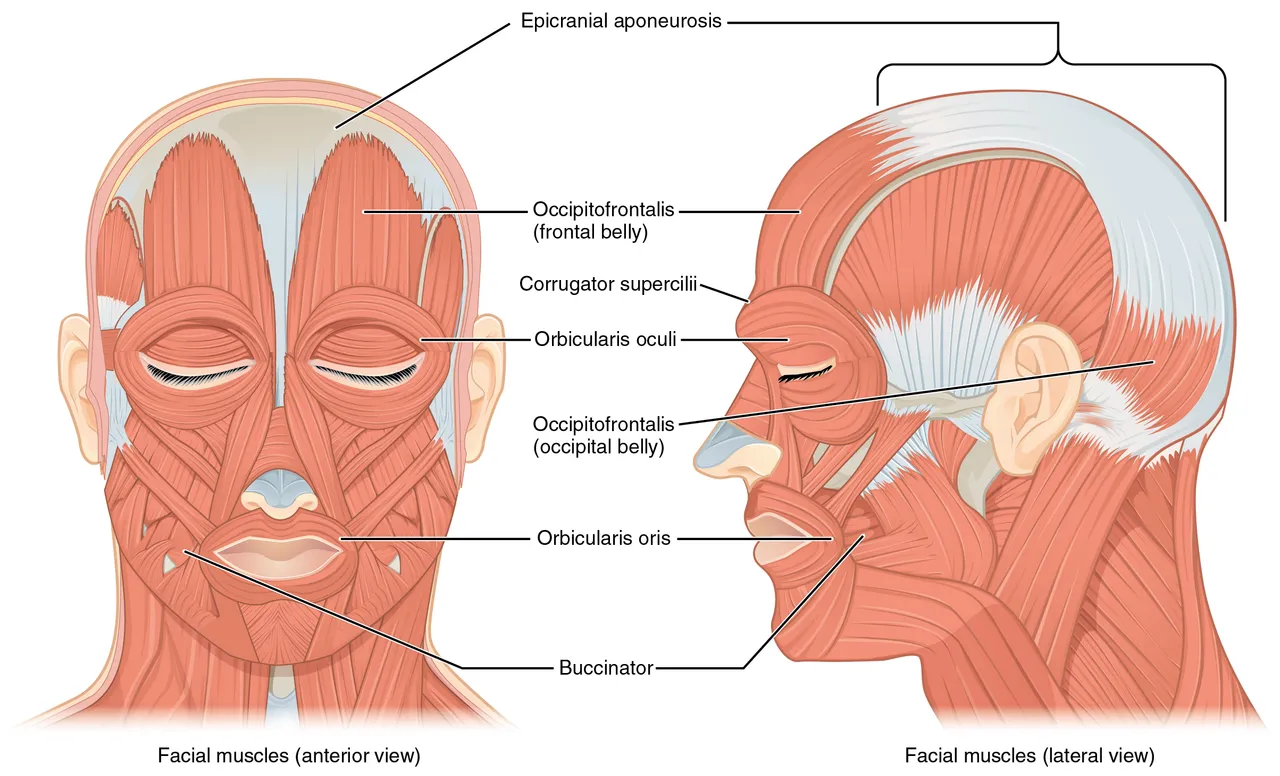 Muscles of facial expression from the front and the side, among them the frontal belly of the occipitofrontalis, the orbicularis oculi and the orbicularis oris, OpenStax Anatomy and PhysiologyWikimedia Commons, OpenStax, CC BY 4.0 (1106 Front and Side Views of the Muscles of Facial Expressions.jpg)
When the facial nerve stops working on one side, as in Bell's palsy, that half of the face hangs still. The eye stays open and the corner of the mouth droops.
Sources
- Susan Standring (ed.), Gray's Anatomy, 42nd ed. (2020), chapter on the face and scalp.
Prev: Muscles in pairsNext: Chewing