Bundles of fibres
This cut through the upper arm shows the biceps and the brachialis in front of the humerus and the triceps behind it. Each muscle is wrapped in a sheath of connective tissue, the epimysium, which runs on into its tendons.
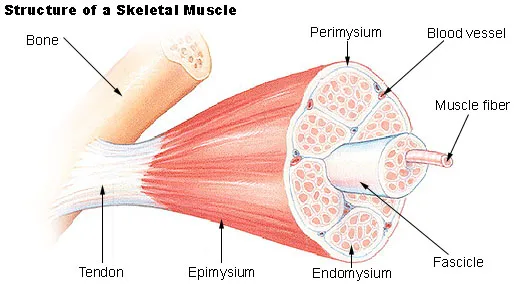 Structure of a skeletal muscle, from the tendon and the epimysium round the whole muscle to the fascicles and the single muscle fibres, NCI SEER TrainingWikimedia Commons, National Cancer Institute SEER Training, Public domain (Illu muscle structure.jpg)
Inside, thinner sheets divide the muscle into bundles called fascicles, the grain seen in a cut of meat. Each fascicle holds many muscle fibres. A fibre is a single cell 10 to 80 micrometres thick with many nuclei, and in most muscles it runs the whole length of the muscle.
Blood vessels and nerves run in the connective tissue between the fascicles, and every fibre lies close to capillaries. At each end the connective tissue gathers into the tendon, so the pull of all the fibres adds up on the bone.
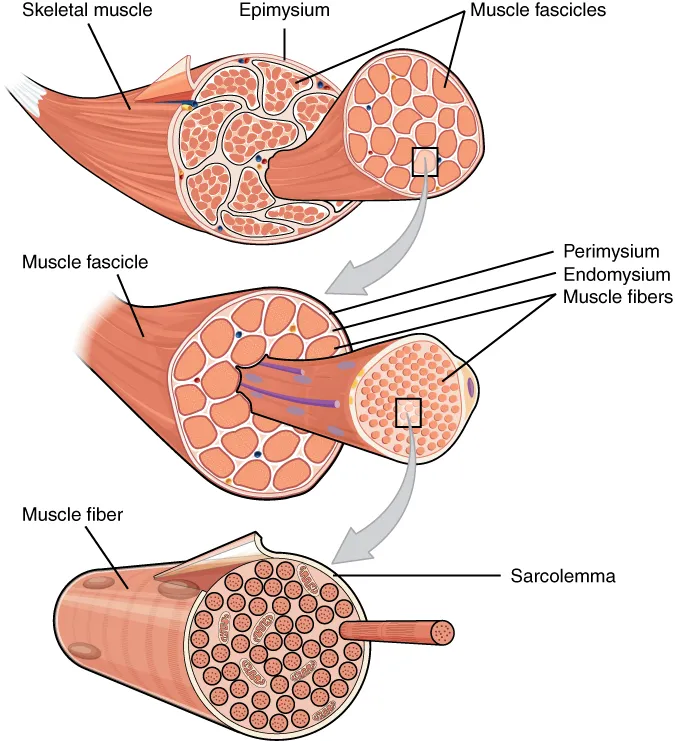 A skeletal muscle opened layer by layer, from the epimysium round the muscle to the fascicles in their perimysium and the fibres in their endomysium, OpenStax Anatomy and PhysiologyWikimedia Commons, OpenStax, CC BY 4.0 (1007 Muscle Fibes (large).jpg)
Sources
- Susan Standring (ed.), Gray's Anatomy, 42nd ed. (2020), chapter on the functional anatomy of the musculoskeletal system.
- Arthur Guyton and John Hall, Textbook of Medical Physiology, 13th ed. (2016), ch. 6.
Prev: Three kinds of muscleNext: The sarcomere