Fast and slow fibres
Muscle fibres come in two types. Slow fibres, type I, contract slowly, burn fat and sugar with oxygen and work for hours without tiring. They are rich in mitochondria, capillaries and myoglobin, a red protein that stores oxygen, so they look red. Fast fibres, type II, contract faster and more strongly, rely more on sugar burned without oxygen and tire quickly.
Every muscle has both, in proportions that suit its work. The soleus, which holds the body upright all day, is over 80 percent slow fibres. The gastrocnemius, used for pushing off and jumping, is about half slow. The tibialis anterior is about 70 percent slow.
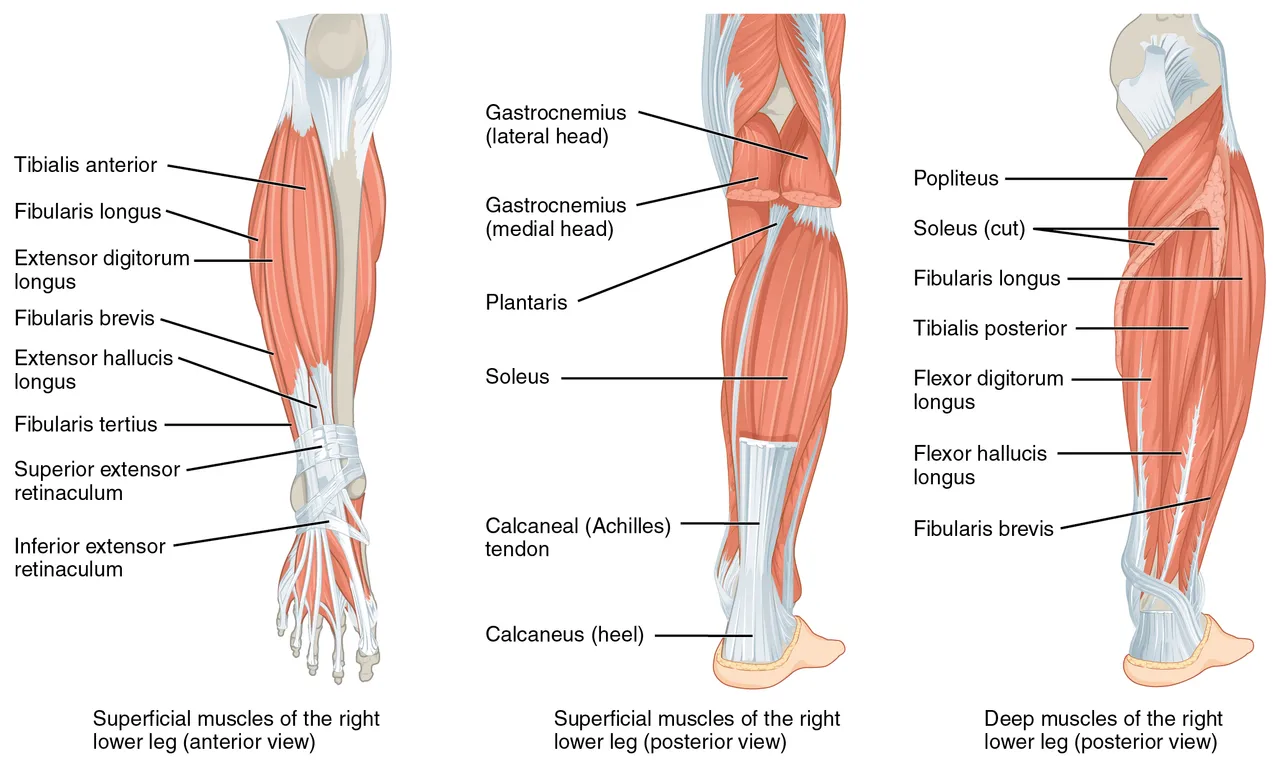 Muscles of the right lower leg, from the front with the tibialis anterior and from behind with the gastrocnemius, the soleus and the Achilles tendon, OpenStax Anatomy and PhysiologyWikimedia Commons, OpenStax, CC BY 4.0 (1123 Muscles of the Leg that Move the Foot and Toes.jpg)
The mix differs between people and is mostly inherited. In the leg muscles of marathon runners about 80 percent of the fibres are slow, in sprinters fewer than 40 percent. In a chicken the leg muscles, used all day for walking, are dark meat, and the breast muscles, used in short bursts of flapping, are white.
Sources
- Arthur Guyton and John Hall, Textbook of Medical Physiology, 13th ed. (2016), ch. 6 and 85.
- M. A. Johnson, J. Polgar, D. Weightman and D. Appleton, Data on the distribution of fibre types in thirty-six human muscles, Journal of the Neurological Sciences 18 (1973): 111-129.
Prev: The front of the legNext: Fuel and fatigue