Fuel and fatigue
A contracting muscle runs on ATP, but a fibre holds only enough for about 3 seconds of hard work. Phosphocreatine stored in the fibre rebuilds ATP, and the two together last 8 to 10 seconds, almost enough for a 100 metre sprint. Breaking down glycogen without oxygen gives about a minute and a half more and makes lactic acid.
For longer work the fibres burn glycogen, fat and other fuels with oxygen in their mitochondria, which can go on for hours. In a long run the quadriceps, hamstrings, gluteus maximus, gastrocnemius and soleus do most of the work and use most of the oxygen.
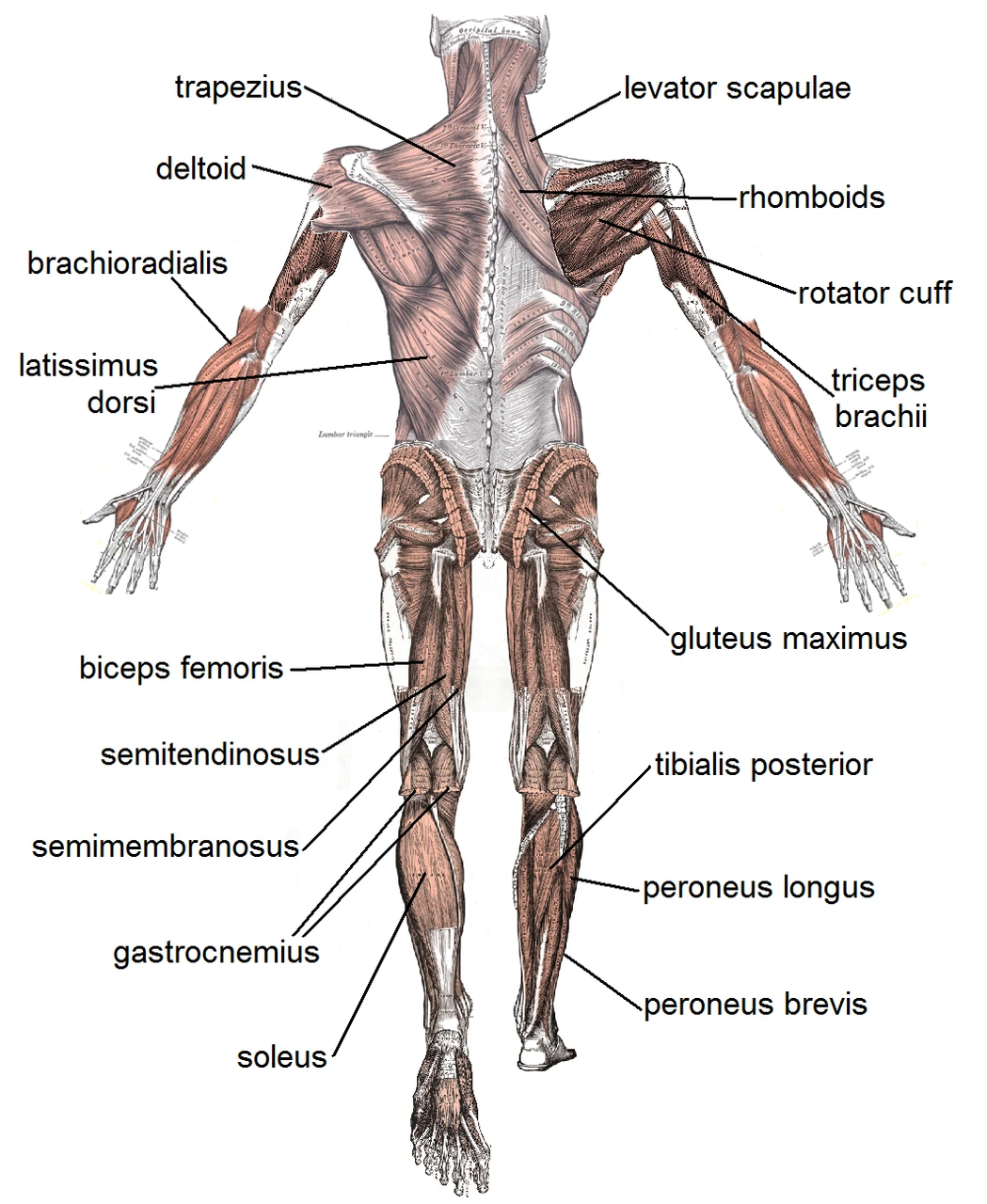 The major muscles of the back of the body, labelled on a collage of Gray's Anatomy platesWikimedia Commons, Mikael Häggström after Gray's Anatomy, Public domain (Muscle posterior labeled.png)
Less than a quarter of the energy a muscle uses becomes movement. The rest becomes heat, which is why exercise warms the body. Fatigue sets in as glycogen runs low and the products of the work build up. A cramp is a painful contraction that goes on by itself, most often in the calf, and stretching the muscle usually eases it.
Sources
- Arthur Guyton and John Hall, Textbook of Medical Physiology, 13th ed. (2016), ch. 6 and 85.
Prev: Fast and slow fibresNext: Use and disuse