Into the hand
The muscles that bend the fingers most strongly sit in the forearm and reach the fingers by long tendons, which keeps the fingers slim. The flexor digitorum superficialis sends a tendon to the middle bone of each finger. The flexor digitorum profundus beneath it sends its tendons through splits in those tendons to the fingertips.
At the wrist these eight tendons and the long flexor tendon of the thumb pass through the carpal tunnel, a channel between the wrist bones and a band across them, the flexor retinaculum. The median nerve goes through with them. Swollen tendon sheaths can press on it and cause carpal tunnel syndrome, with tingling in the thumb and first fingers.
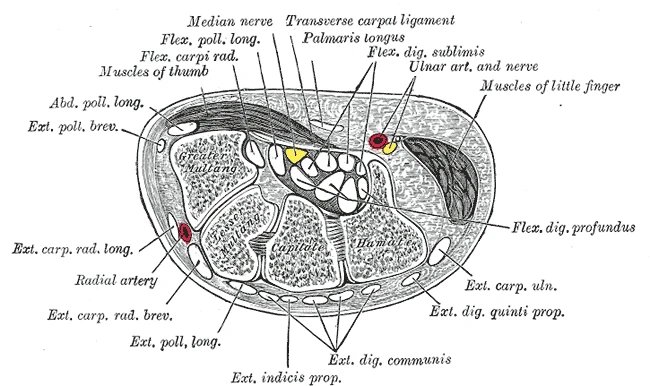 A cut across the wrist, with the flexor tendons and the median nerve passing through the carpal tunnel under the transverse carpal ligament, Gray's Anatomy, 1918, figure 422Wikimedia Commons, Henry Vandyke Carter, Public domain (Gray422.png)
About 20 small muscles lie inside the hand itself. The thenar muscles form the ball of the thumb, the hypothenar muscles the edge of the palm by the little finger, and the interossei and lumbricals lie between the bones. They make the fine movements of the fingers, and the story of the hand covers them.
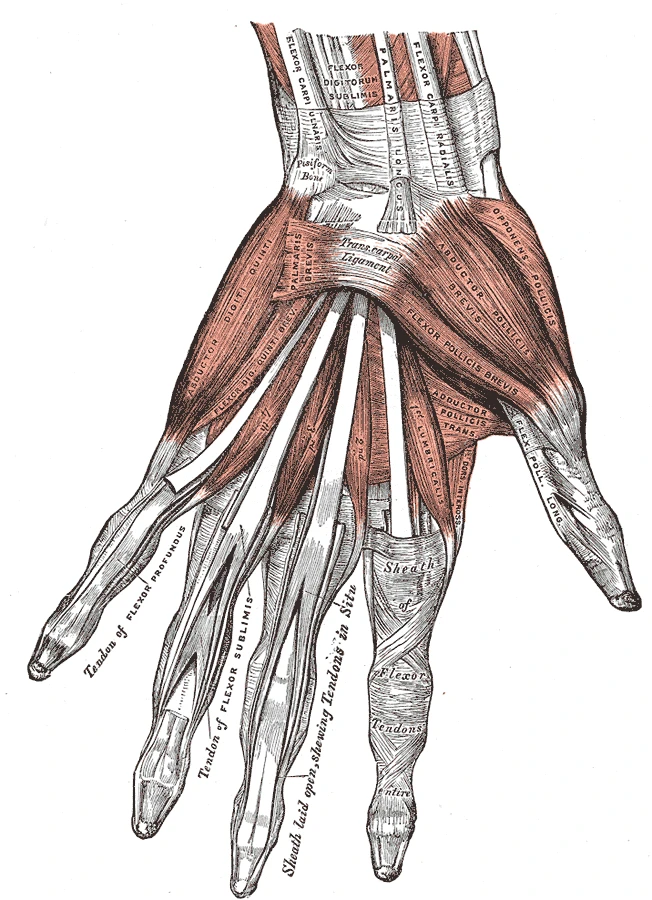 Muscles of the palm, with the thenar and hypothenar muscles and the long flexor tendons running into the fingers, Gray's Anatomy, 1918, figure 427Wikimedia Commons, Henry Vandyke Carter, Public domain (Gray427.png)
Sources
- Susan Standring (ed.), Gray's Anatomy, 42nd ed. (2020), chapters on the elbow and forearm and on the wrist and hand.
Prev: The forearmNext: The buttock