Iliopsoas
The strongest muscle that bends the hip lies inside the abdomen and pelvis. The psoas major starts on the sides of the lumbar vertebrae and the last thoracic vertebra. The iliacus fills the hollow on the inner side of the hip bone. Together they form the iliopsoas.
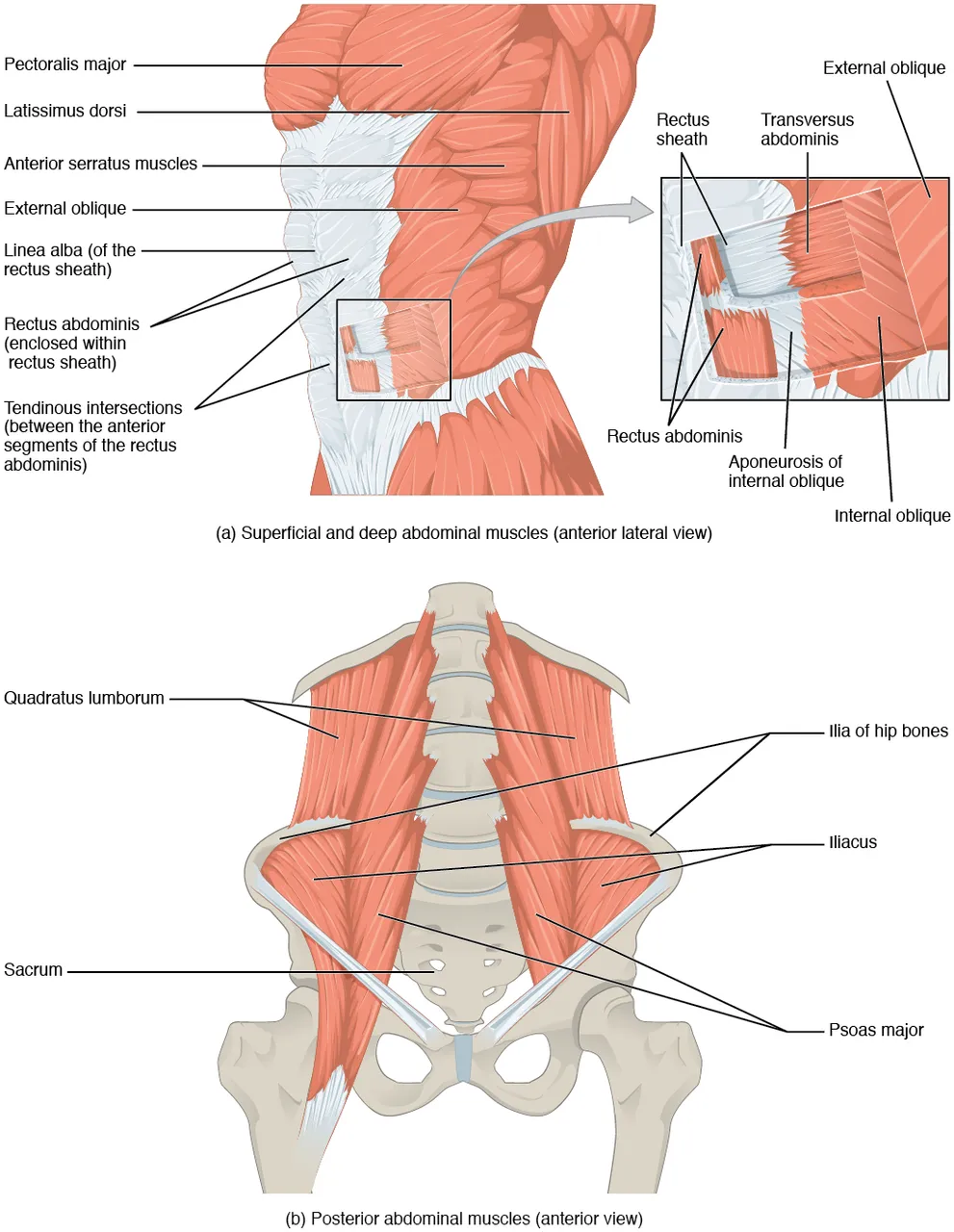 Muscles of the abdomen, the rectus abdominis beside the linea alba and the three flat muscles of the flank in front, and the psoas major, the iliacus and the quadratus lumborum on the back wall, OpenStax Anatomy and PhysiologyWikimedia Commons, OpenStax, CC BY 4.0 (1112 Muscles of the Abdomen.jpg)
The two pass under the inguinal ligament into the thigh and end on one tendon on the lesser trochanter of the femur. The iliopsoas lifts the thigh forward in walking, running and climbing. When the legs are fixed, as in a sit-up, it bends the trunk forward at the hips.
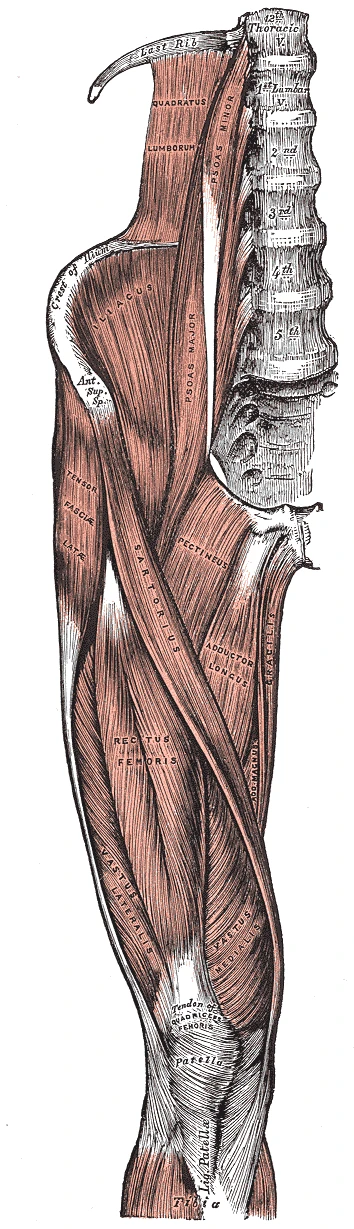 Muscles of the iliac region and the front of the thigh, with the psoas major and the iliacus, the sartorius and the quadriceps, Gray's Anatomy, 1918, figure 430Wikimedia Commons, Henry Vandyke Carter, Public domain (Gray430.png)
The psoas lies against the back wall of the abdomen. Inflammation of an organ next to it, such as the appendix on the right, can make it painful to stretch the hip backward. Doctors test for this as the psoas sign.
Sources
- Susan Standring (ed.), Gray's Anatomy, 42nd ed. (2020), chapters on the posterior abdominal wall and on the pelvic girdle, gluteal region and thigh.
Prev: The buttockNext: The quadriceps