Levers
Bones work as levers and joints as their pivots. At the elbow the pivot is the joint and the load is in the hand, about 35 centimetres away. The biceps and the brachialis pull about 5 centimetres from the pivot. The muscles act between the pivot and the load, which makes this a third-class lever.
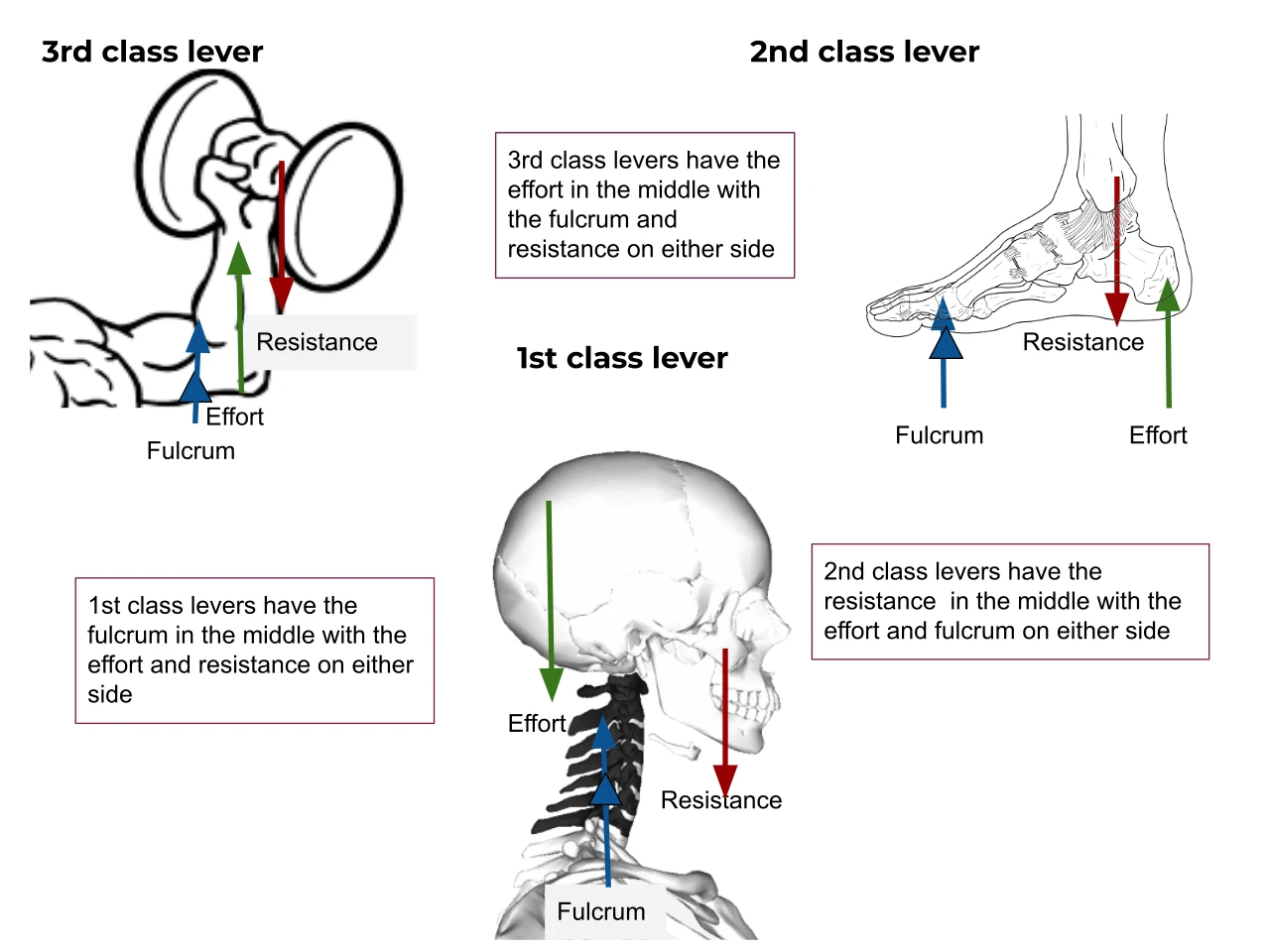 The three classes of lever in the body, the head balanced on the neck as the first class, rising onto the toes as the second and the forearm lifting a weight as the thirdWikimedia Commons, Ncl3167, CC BY-SA 4.0 (Levers of the Human Body.svg), white background added
Such a lever costs force. To hold a 5 kilogram weight in the hand with the forearm level, the elbow flexors must pull with about seven times as much, some 35 kilograms. In return, when the muscle shortens by 1 centimetre the hand moves about 7 centimetres, so it travels far and fast.
The brachialis runs from the front of the humerus to the ulna, under the biceps. The ulna does not turn with the forearm, so the brachialis bends the elbow with the same force whether the palm faces up or down. It is the main flexor of the elbow.
Sources
- Susan Standring (ed.), Gray's Anatomy, 42nd ed. (2020), chapters on the functional anatomy of the musculoskeletal system and on the elbow and forearm.
Prev: Origin and insertionNext: Muscles in pairs