The motor unit
Each fibre takes its orders from one motor neuron in the spinal cord. The neuron's axon branches in the muscle, and each branch ends on one fibre at a neuromuscular junction. There the nerve ending releases acetylcholine, which starts an impulse in the fibre. One neuron and all the fibres it supplies form a motor unit.
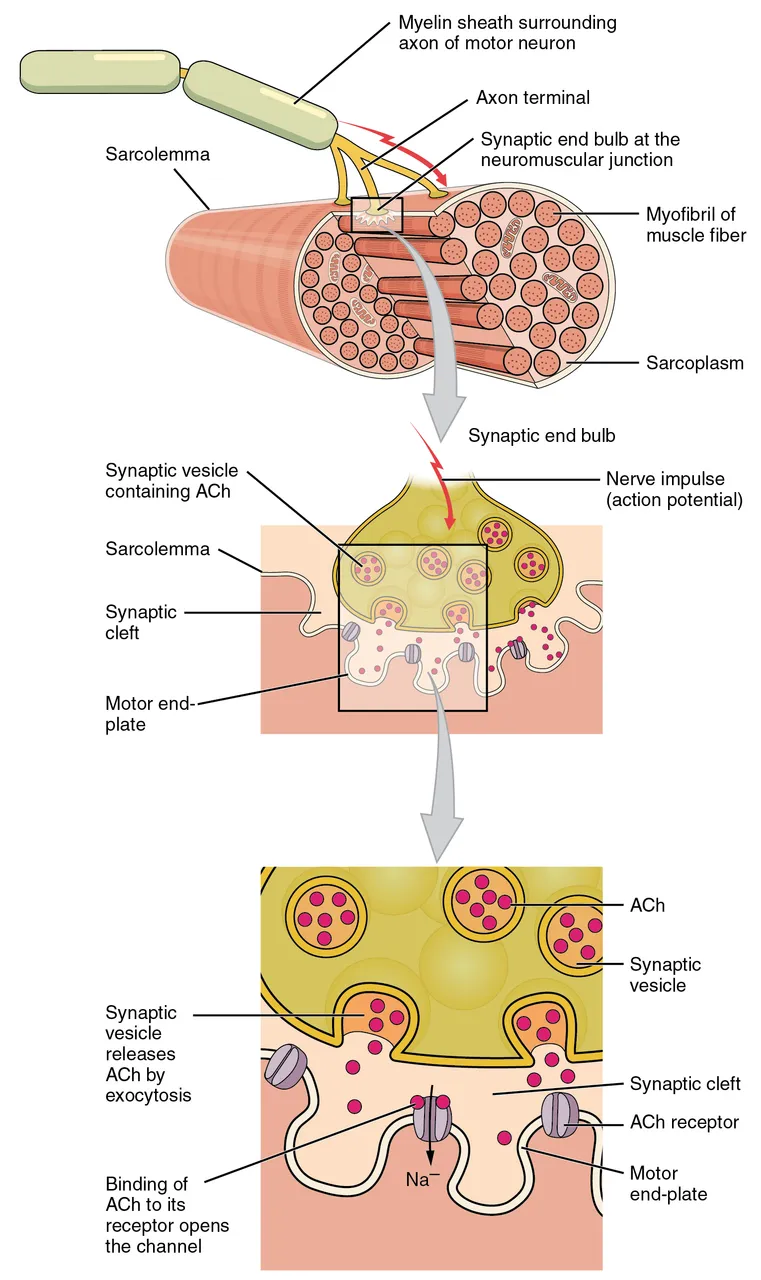 A motor axon ending on a muscle fibre, with the neuromuscular junction enlarged to show acetylcholine released onto its receptors at the motor end plate, OpenStax Anatomy and PhysiologyWikimedia Commons, OpenStax, CC BY 4.0 (1009 Motor End Plate and Innervation.jpg)
The musculocutaneous nerve, from the fifth and sixth cervical segments, supplies the coracobrachialis, the biceps and the brachialis. Muscles that need fine control have small units: in some muscles of the larynx one neuron supplies two or three fibres. In the soleus of the calf one neuron supplies several hundred.
A unit contracts fully or not at all. The nervous system grades force by calling on more units, small ones first, and by firing each one faster. Impulses that come fast enough fuse the separate twitches into one smooth, steady contraction.
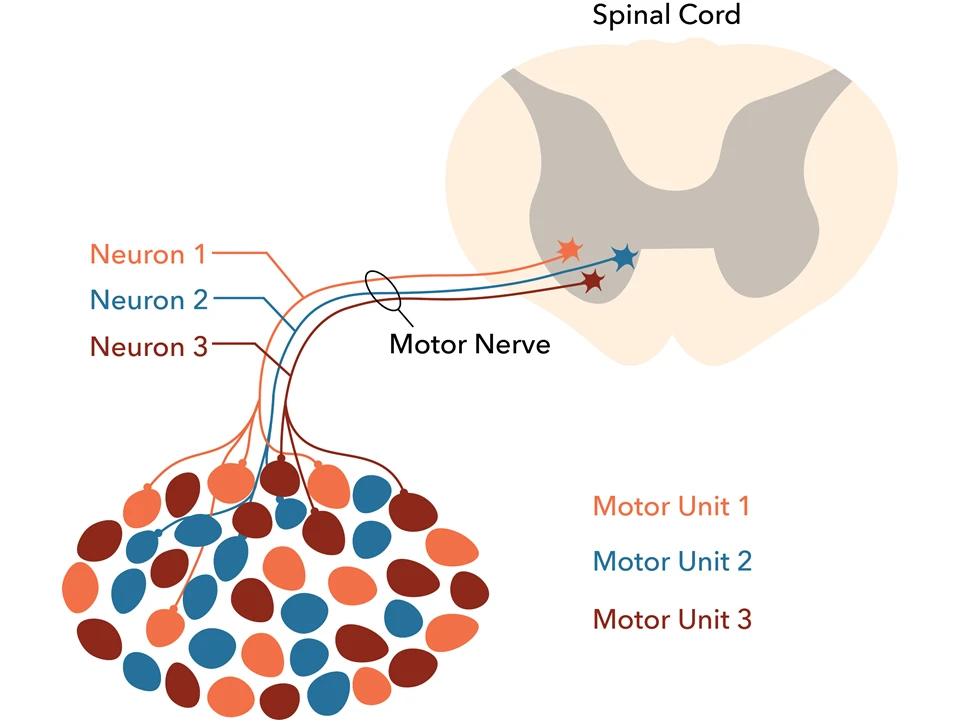 Three motor units, each a motor neuron in the spinal cord with its own scattered set of fibres in the muscleWikimedia Commons, Daniel Walsh and Alan Sved, CC BY-SA 4.0 (Motor unit.png)
Sources
- Arthur Guyton and John Hall, Textbook of Medical Physiology, 13th ed. (2016), ch. 6 and 7.
- Susan Standring (ed.), Gray's Anatomy, 42nd ed. (2020), chapter on the shoulder girdle and arm.
Prev: Cross-bridgesNext: Origin and insertion