The neck
The sternocleidomastoid runs up the side of the neck from the sternum and clavicle to the mastoid process behind the ear. One contracting alone tilts the head toward its own shoulder and turns the face to the other side. The two together bend the neck forward.
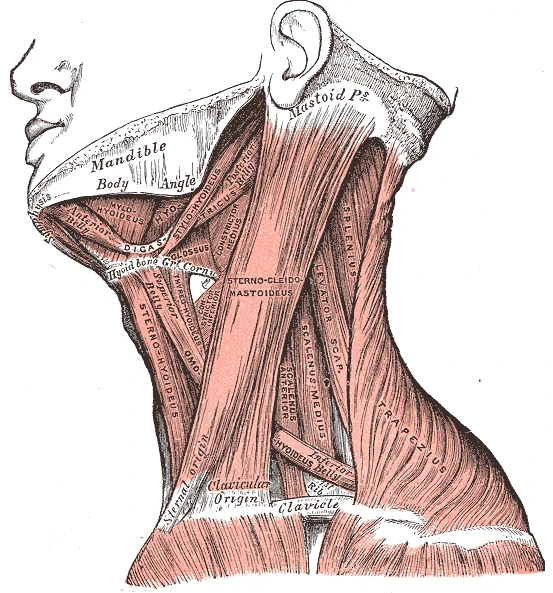 Muscles of the neck from the side, with the sternocleidomastoid running from the sternum and clavicle to the mastoid process and the trapezius behind it, Gray's Anatomy, 1918, figure 385Wikimedia Commons, Henry Vandyke Carter, Public domain (Gray385.png)
The trapezius is a flat sheet over the back of the neck and the upper back, from the skull and the spines of the vertebrae to the clavicle and the scapula. Its upper fibres shrug the shoulders and carry the weight of the arms. Its middle and lower fibres pull the shoulder blades together and down.
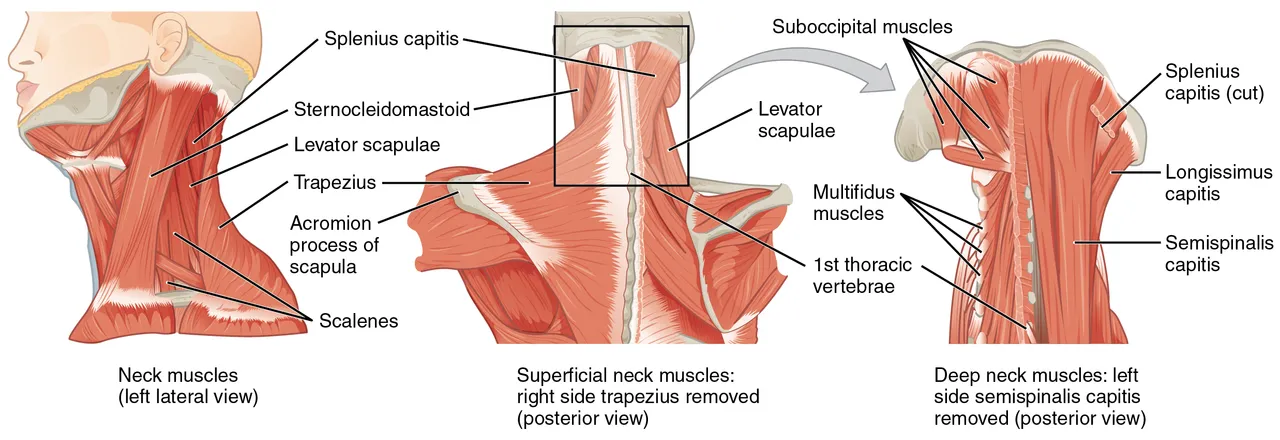 Muscles of the neck from the side and from behind, with the sternocleidomastoid, the trapezius and the deeper muscles under them, OpenStax Anatomy and PhysiologyWikimedia Commons, OpenStax, CC BY 4.0 (1111 Posterior and Side Views of the Neck.jpg)
Both muscles are supplied by the accessory nerve, the eleventh cranial nerve. A doctor tests it by asking the patient to shrug against resistance and to turn the head against a hand.
Sources
- Susan Standring (ed.), Gray's Anatomy, 42nd ed. (2020), chapters on the neck and the back.
Prev: ChewingNext: The chest