Origin and insertion
A muscle pulls on bone through its tendons, cords of collagen that barely stretch. The end that stays still in most movements is the origin, usually the end nearer the trunk. The end that moves is the insertion. The biceps has two origins on the scapula and one insertion on the radius, just below the elbow.
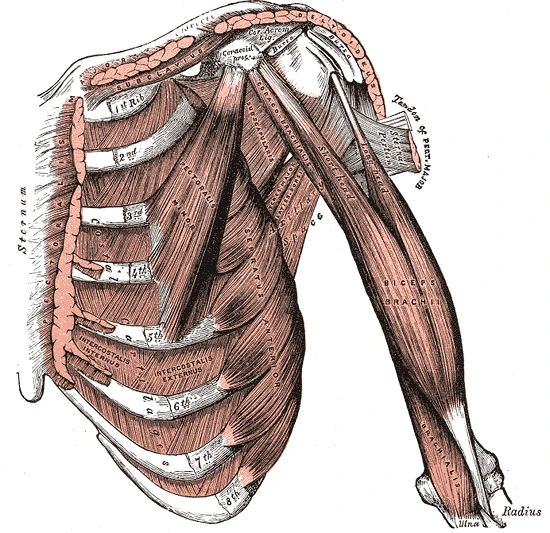 Deep muscles of the chest and the front of the arm, with the short and long heads of the biceps coming from the scapula, the pectoralis minor, the serratus anterior and the intercostals, Gray's Anatomy, 1918, figure 411Wikimedia Commons, Henry Vandyke Carter, Public domain (Gray411.png)
Its long head starts above the socket of the shoulder joint, and its tendon runs through the joint and down a groove in the humerus. Its short head starts on the coracoid process, a hook of the scapula in front of the shoulder. The two bellies join in the arm and end in a strong tendon on the radius.
Because it pulls on the radius, the biceps both bends the elbow and turns the palm up, the movement that drives in a screw with the right hand. It turns the forearm most strongly when the elbow is bent at a right angle.
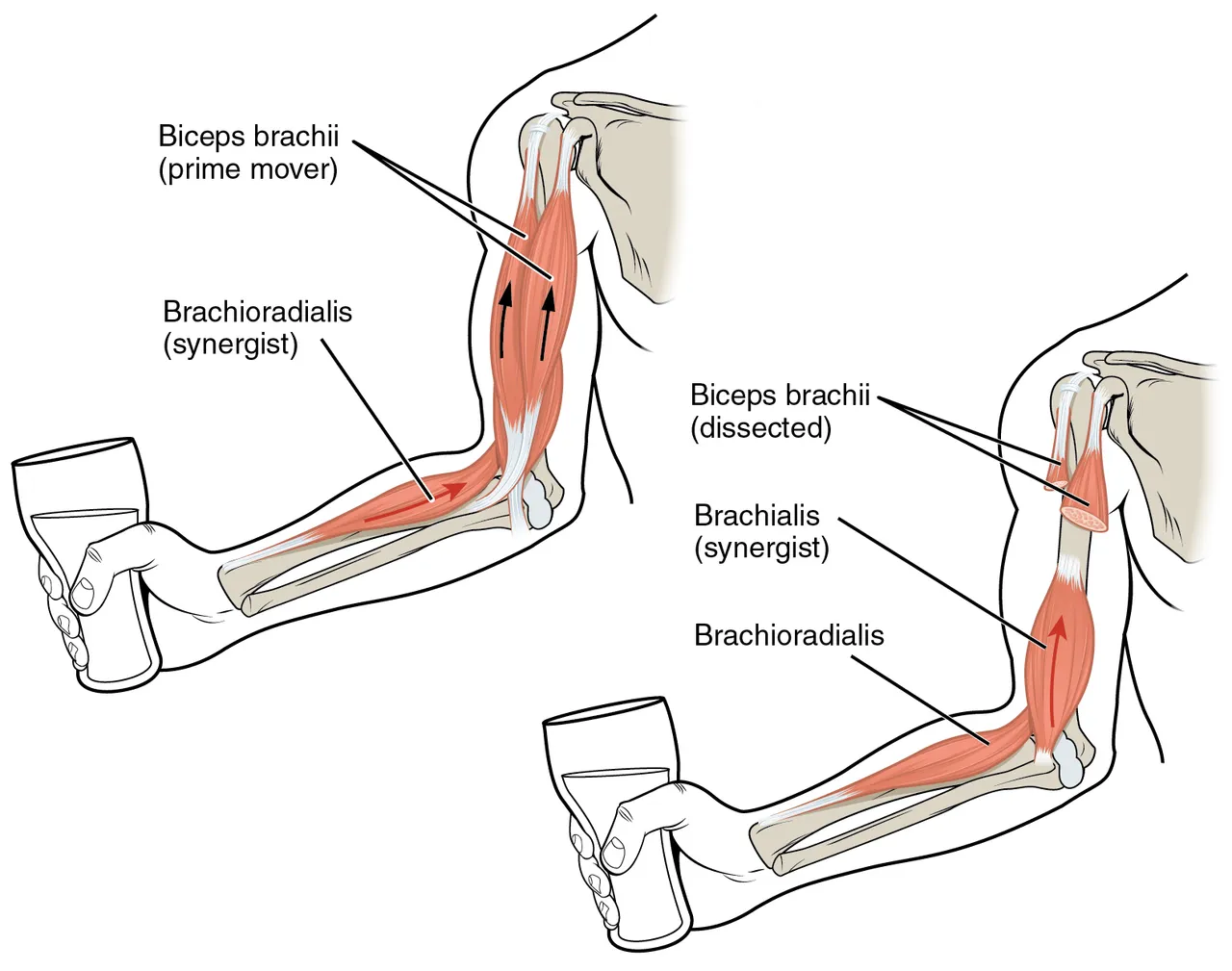 The biceps brachii bending the elbow to lift a glass, helped by the brachioradialis and by the brachialis beneath it, OpenStax Anatomy and PhysiologyWikimedia Commons, OpenStax College, CC BY 4.0 (Biceps Muscle CNX.jpg)
Sources
- Susan Standring (ed.), Gray's Anatomy, 42nd ed. (2020), chapter on the shoulder girdle and arm.
Prev: The motor unitNext: Levers