Muscles in pairs
A muscle can only pull, so each movement has a muscle that undoes it. At the elbow the biceps bends the joint and the triceps on the back of the arm straightens it. The muscle that makes a movement is called the agonist, and the one that opposes it the antagonist.
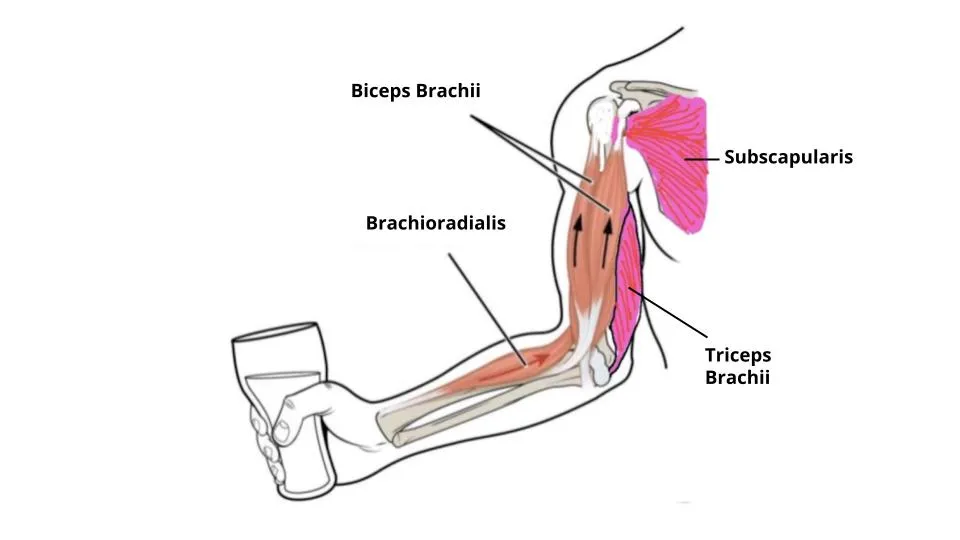 Lifting a glass, the biceps brachii works as the prime mover and the triceps brachii on the back of the arm as its antagonist, with the brachioradialis and the subscapularis helpingWikimedia Commons, Rachel Sanchez Thwing after OpenStax, CC BY-SA 4.0 (Prime Mover Synergist Fixator Antagonist.jpg)
The triceps has three heads. The long head starts on the scapula below the shoulder socket, the lateral and medial heads on the back of the humerus. All three end on the olecranon, the point of the elbow. The triceps straightens the elbow in pushing, throwing and getting up from a chair with the arms.
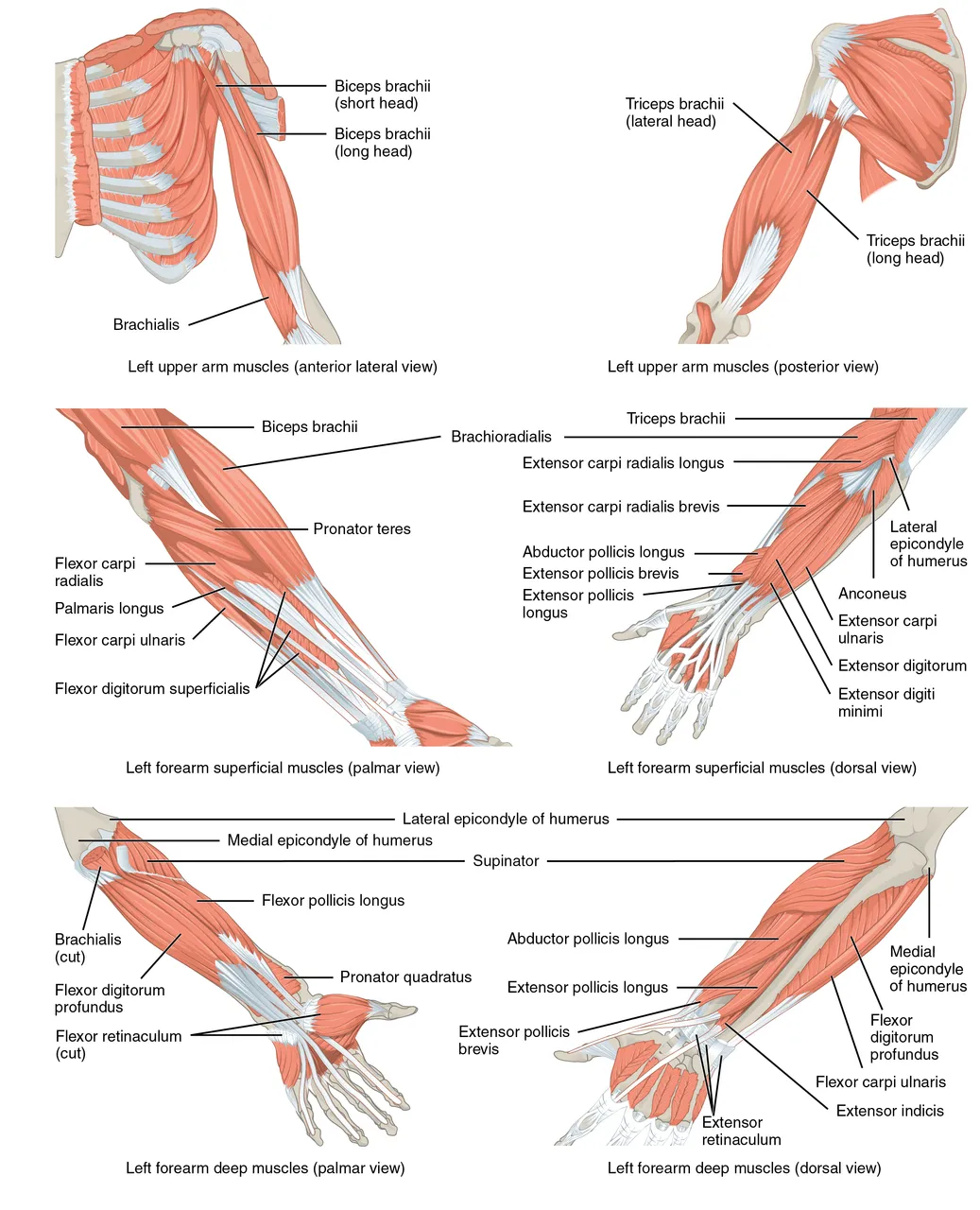 Muscles of the left arm and forearm, with the two heads of the biceps and two heads of the triceps above and the superficial and deep forearm muscles below, OpenStax Anatomy and PhysiologyWikimedia Commons, OpenStax, CC BY 4.0 (1120 Muscles that Move the Forearm.jpg)
When the biceps contracts, nerve circuits in the spinal cord relax the triceps, and the other way round. The two can also work together at low force to hold the elbow steady while the hand does careful work.
Sources
- Susan Standring (ed.), Gray's Anatomy, 42nd ed. (2020), chapter on the shoulder girdle and arm.
- Arthur Guyton and John Hall, Textbook of Medical Physiology, 13th ed. (2016), ch. 55.
Prev: LeversNext: The face