The sarcomere
A muscle fibre is packed with hundreds to thousands of myofibrils, threads about one micrometre thick that run its whole length. Each myofibril is a chain of short units, the sarcomeres, joined end to end at thin plates called Z discs. In the biceps a single myofibril holds tens of thousands of sarcomeres in a row.
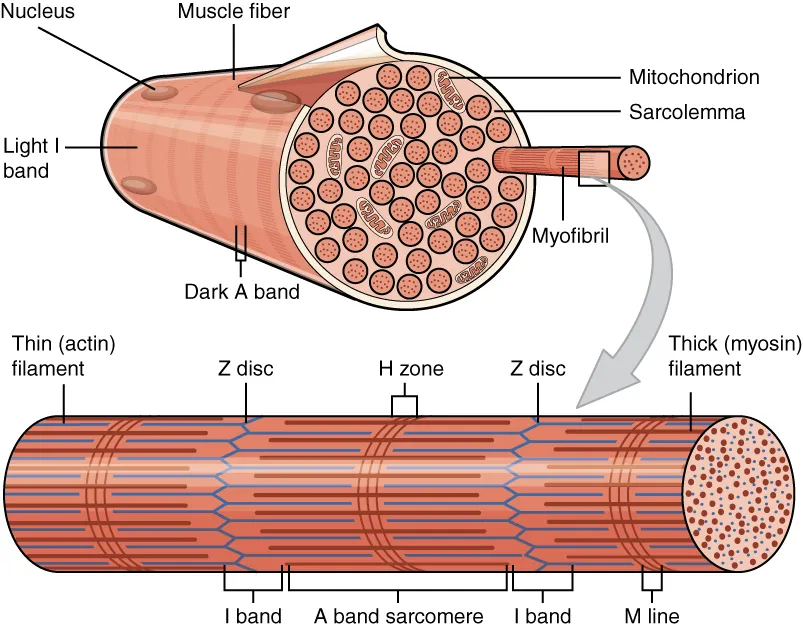 A muscle fibre packed with myofibrils, and one myofibril with its sarcomeres, Z discs, light I bands and dark A bands, OpenStax Anatomy and PhysiologyWikimedia Commons, OpenStax, CC BY 4.0 (1002 Organization of Muscle Fiber.jpg)
A sarcomere is about 2 micrometres long. Thin filaments of the protein actin reach in from each Z disc. Between them lie thick filaments of myosin, about 1.6 micrometres long. The length of the myosin looks dark, the A band. Near the Z discs, where there is actin alone, the sarcomere looks light, the I band.
The bands of neighbouring myofibrils line up across the fibre. This gives skeletal and cardiac muscle the stripes seen under the microscope.
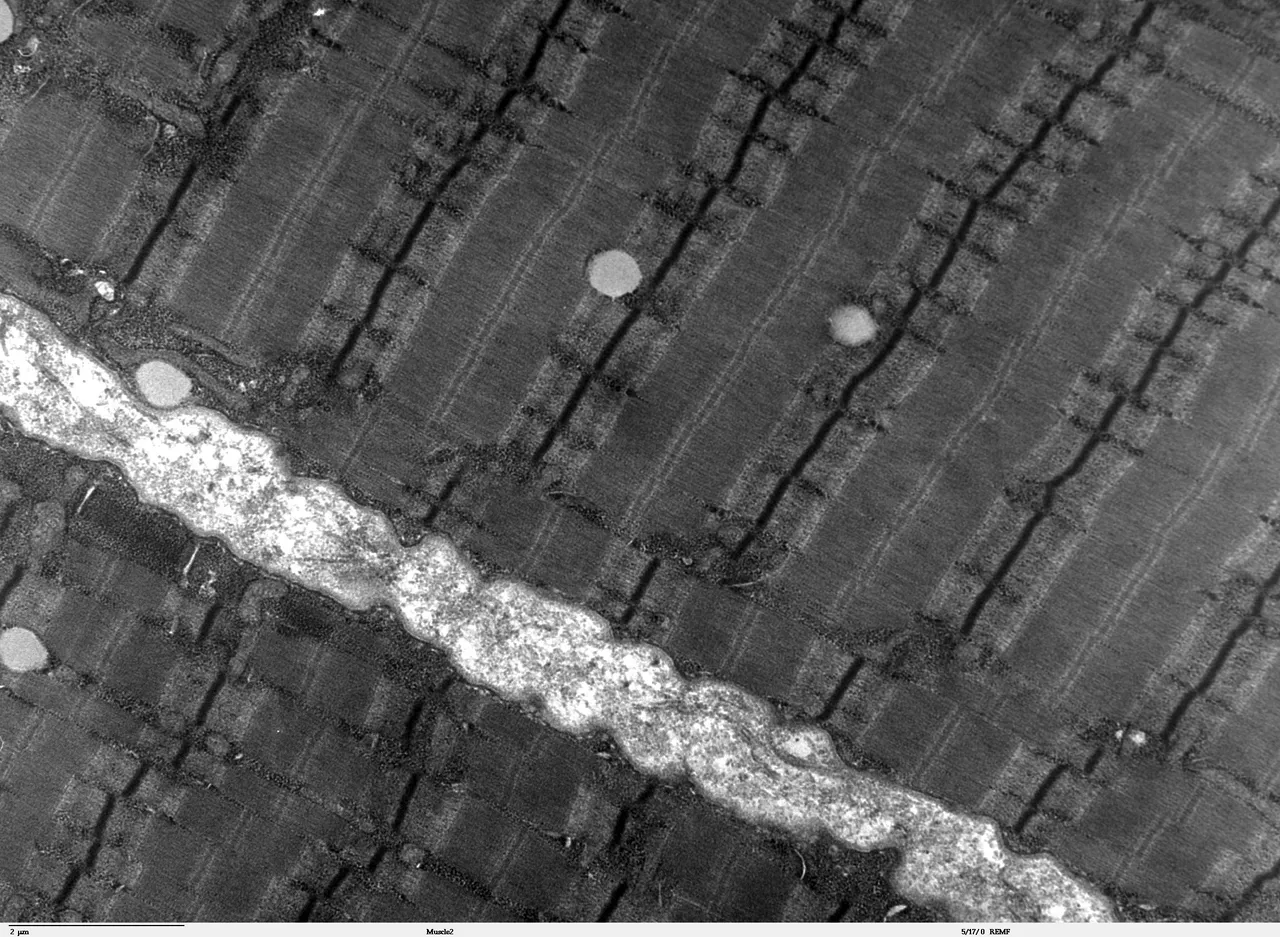 Human skeletal muscle under the electron microscope, its myofibrils banded by the repeated sarcomeres, Dartmouth Electron Microscope FacilityWikimedia Commons, Louisa Howard, Public domain (Human skeletal muscle tissue 1 - TEM.jpg)
Sources
- Arthur Guyton and John Hall, Textbook of Medical Physiology, 13th ed. (2016), ch. 6.
- Susan Standring (ed.), Gray's Anatomy, 42nd ed. (2020), chapter on the functional anatomy of the musculoskeletal system.
Prev: Bundles of fibresNext: Cross-bridges