Three kinds of muscle
Muscle tissue comes in three kinds. Skeletal muscle, such as the biceps of the arm, moves the bones and obeys the will. Its cells are long fibres with many nuclei, and under the microscope they show fine cross stripes, so it is also called striated muscle.
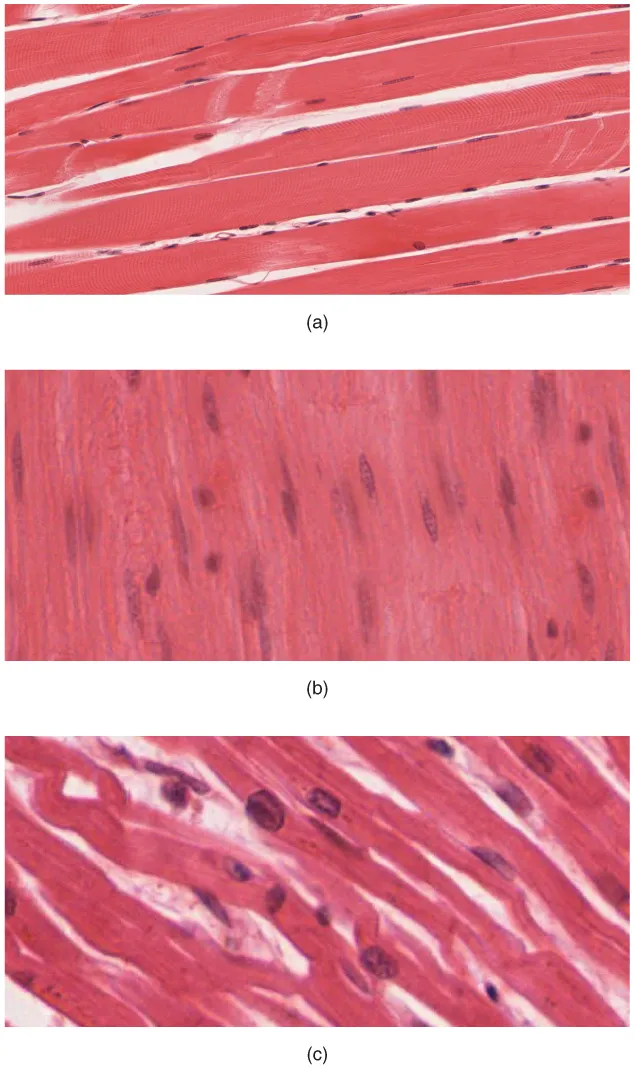 Skeletal, smooth and cardiac muscle under the light microscope, from top to bottom, OpenStax Anatomy and PhysiologyWikimedia Commons, OpenStax, CC BY 4.0 (414 Skeletal Smooth Cardiac.jpg)
Cardiac muscle forms the wall of the heart. It is striated too, but its cells are short and branched and joined end to end by intercalated discs, which pass the signal from cell to cell. It contracts in its own rhythm, about 70 times a minute at rest, and keeps working throughout life.
Smooth muscle lines the walls of hollow organs such as the stomach, the intestines, the blood vessels, the airways and the bladder. Its spindle-shaped cells have no stripes. It contracts slowly and can stay contracted for a long time on little energy. Cardiac and smooth muscle work without conscious control.
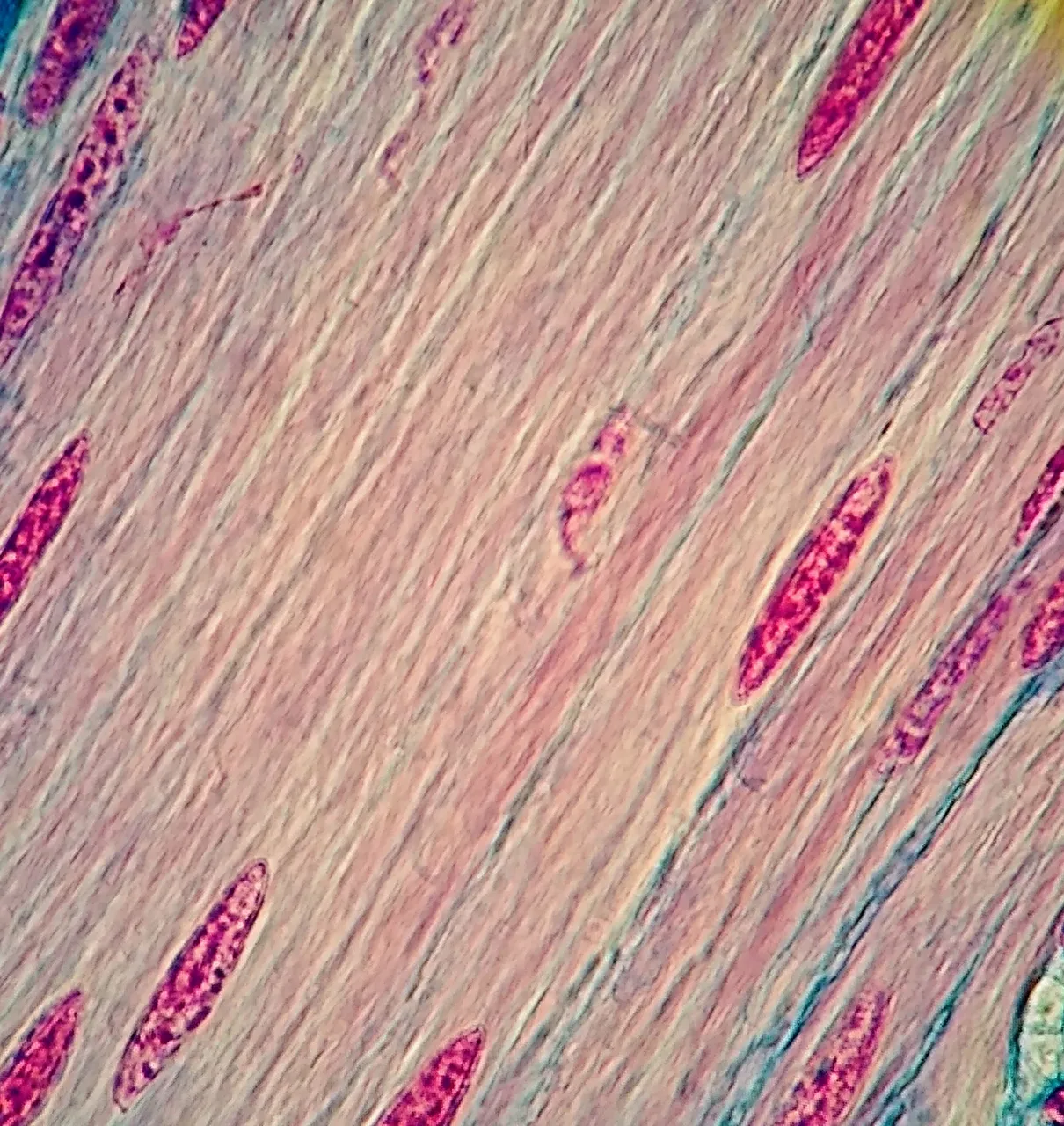 Smooth muscle under the light microscope at 400 times, its spindle-shaped cells each with one long nucleusWikimedia Commons, Alexander G. Cheroske, CC BY-SA 4.0 (Smooth muscle 400x.jpg)
Sources
- Arthur Guyton and John Hall, Textbook of Medical Physiology, 13th ed. (2016), ch. 6, 8 and 9.
- Susan Standring (ed.), Gray's Anatomy, 42nd ed. (2020), chapter on the functional anatomy of the musculoskeletal system.
Prev: Over 600 musclesNext: Bundles of fibres