Three layers
Under the external oblique lie two more flat muscles, shown here on opposite sides. The internal oblique runs at right angles to the external, up and forward from the hip bone and the lower back. Under it the transversus abdominis runs straight round the abdomen like a belt.
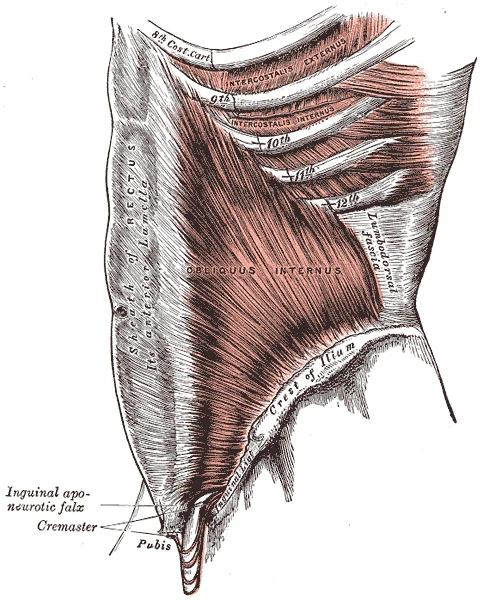 The internal oblique of the left side, with the external oblique removed, Gray's Anatomy, 1918, figure 395Wikimedia Commons, Henry Vandyke Carter, Public domain (Gray395.png)
Three layers with fibres in different directions make a wall that resists strain in every direction, as plywood does. In front, the aponeuroses of all three wrap around the rectus abdominis as its sheath and meet those of the other side at the linea alba.
The transversus is the deepest. Its contraction pulls the wall in and raises the pressure inside the abdomen. It tightens just before the arms or legs move, which steadies the lower back.
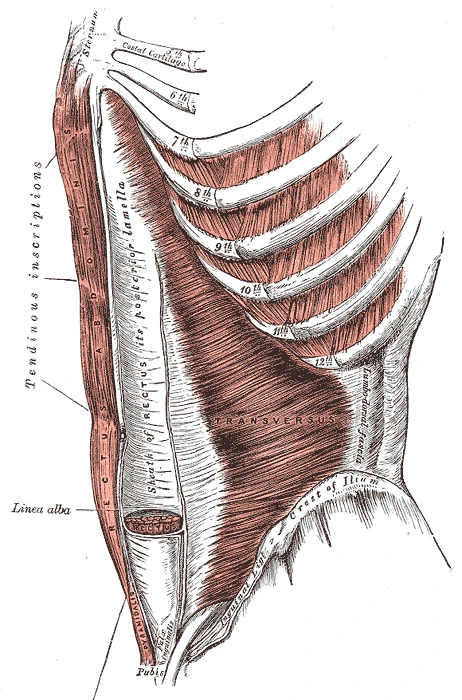 The transversus abdominis and the rectus abdominis, with the obliques removed and the rectus sheath opened, Gray's Anatomy, 1918, figure 397Wikimedia Commons, Henry Vandyke Carter, Public domain (Gray397.png)
Sources
- Susan Standring (ed.), Gray's Anatomy, 42nd ed. (2020), chapters on the anterior abdominal wall and the posterior abdominal wall.
- Paul Hodges and Carolyn Richardson, Contraction of the abdominal muscles associated with movement of the lower limb, Physical Therapy 77 (1997): 132-142.
Prev: The abdominal wallNext: The broad muscles of the back