Use and disuse
Heavy loads make muscle fibres thicker as they add actin and myosin filaments, while the number of fibres stays about the same. A few contractions a day above half of the maximal force build strength faster than many light ones. Strength rises about 30 percent in the first 6 to 8 weeks of training, then levels off.
Without use a muscle wastes, because its proteins are broken down faster than they are made. The muscles that hold the body up against gravity, in the back, buttocks, thighs and calves, shrink fastest in bed rest or in space.
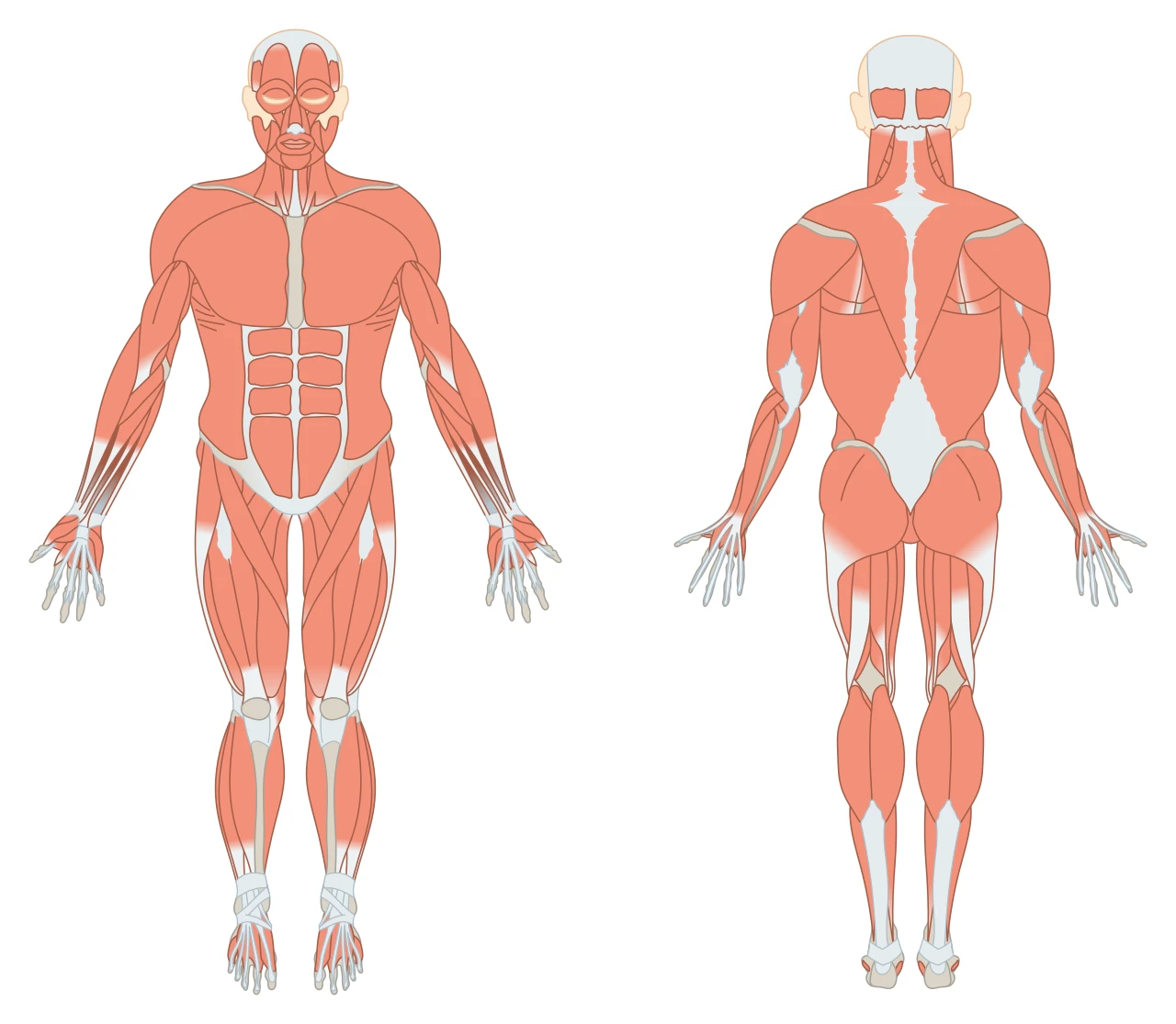 Outline of the superficial muscles from the front and from the back, drawn after OpenStaxWikimedia Commons, OpenStax, Tomáš Kebert and umimeto.org, CC BY-SA 4.0 (Muscles front and back.svg), white background added
A muscle also adapts its length. Kept stretched, it adds sarcomeres at the ends of its fibres. Kept short, as in a plaster cast, it loses some, and it takes stretching to bring the length back.
Sources
- Arthur Guyton and John Hall, Textbook of Medical Physiology, 13th ed. (2016), ch. 6 and 85.
- Gregory Adams, Vincent Caiozzo and Kenneth Baldwin, Skeletal muscle unweighting: spaceflight and ground-based models, Journal of Applied Physiology 95 (2003): 2185-2201.
Prev: Fuel and fatigueNext: Vesalius's muscle men