1543
Vesalius's muscle men
In 1543 Andreas Vesalius, a 28-year-old professor of anatomy at Padua, published De humani corporis fabrica, On the Fabric of the Human Body. He based it on human bodies he had dissected himself. Teaching until then followed the Greek physician Galen, who had dissected apes and other animals, and Vesalius showed where Galen's descriptions did not fit the human body.
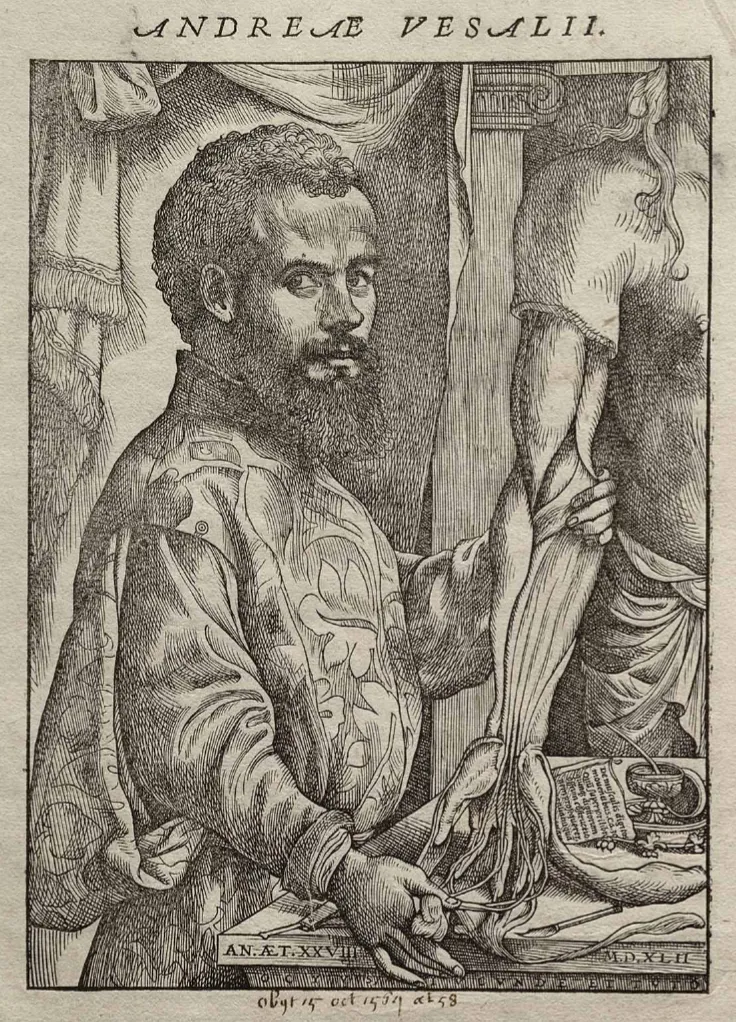 Andreas Vesalius at 28, from the Fabrica, 1543Wikimedia Commons, attributed to Jan van Calcar, Public domain (Vesalius Fabrica portrait.jpg)
The second of its seven books covers the muscles. Its full-page woodcuts show a man standing in a landscape, with a layer of muscle taken away on each plate until the bones show. Set side by side, the backgrounds join into one view of the hills near Padua. The drawings are usually credited to artists from Titian's workshop in Venice.
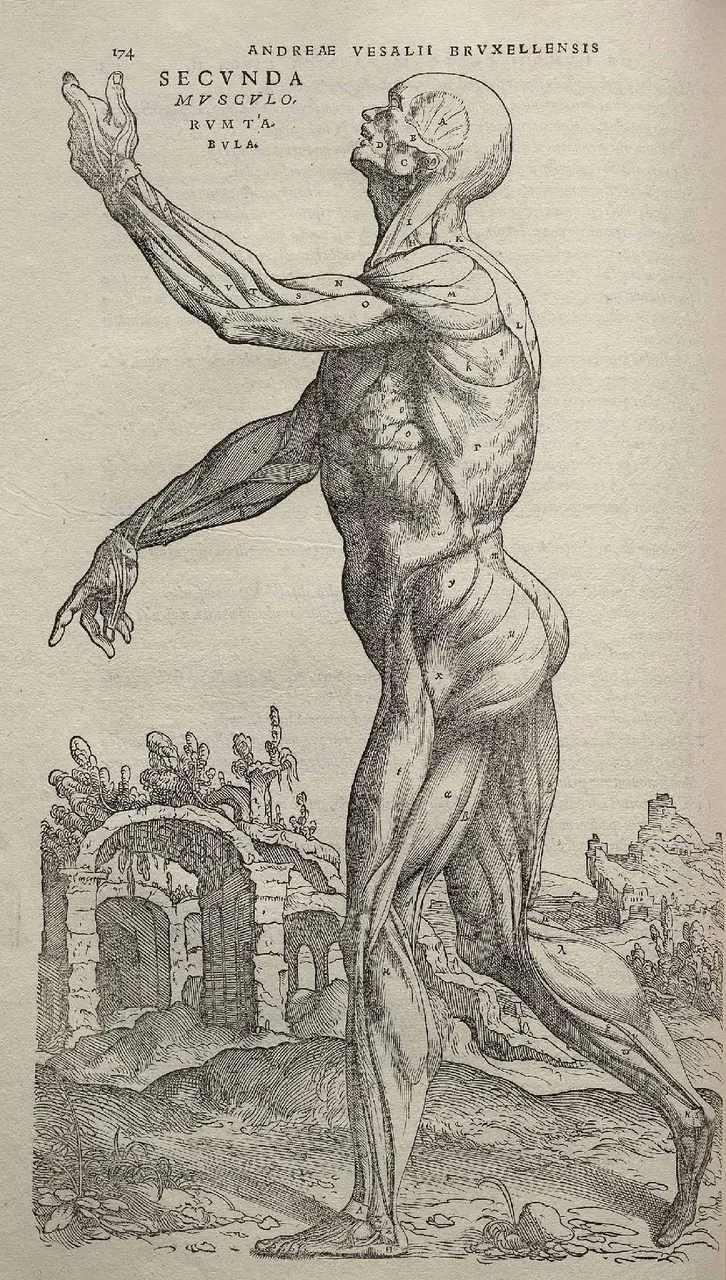 The second plate of the muscles in Vesalius's De humani corporis fabrica, 1543, a man seen from the side with the skin removedWikimedia Commons, Andreas Vesalius, Public domain (Vesalius Fabrica p174.jpg)
Sources
- Andreas Vesalius, De humani corporis fabrica libri septem (Basel: Johannes Oporinus, 1543), book II.
- Daniel Garrison and Malcolm Hast (trans.), The Fabric of the Human Body (Basel: Karger, 2014).
Prev: Use and disuseNext: Duchenne's faces