The basal ganglia
Deep in each hemisphere lie clusters of grey matter called the basal ganglia. The caudate nucleus curls like a tail beside the lateral ventricle. The putamen lies further out, and inside it sits the globus pallidus, the pale globe. Loops run from the cortex through these nuclei and the thalamus back to the cortex.
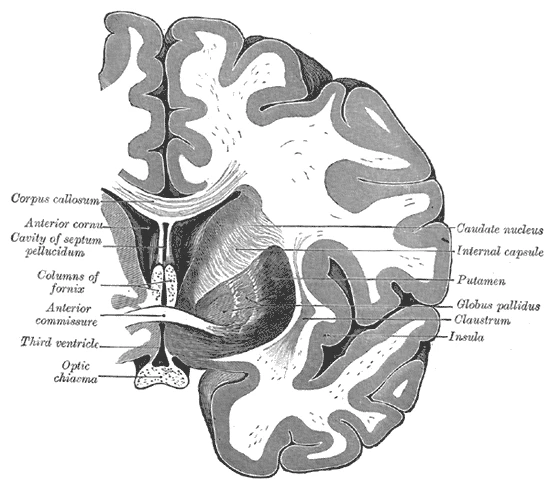 Coronal section through the anterior commissure, with the caudate nucleus, putamen and globus pallidus and the internal capsule between them, Gray's Anatomy, 20th edition, 1918, figure 744Wikimedia Commons, Henry Vandyke Carter, Public domain (Gray744.png)
The loops select which movement to make and hold back the rest. They depend on dopamine from a small dark nucleus of the midbrain, the substantia nigra. When its cells die, movements grow slow and small and the hands shake at rest. James Parkinson described this shaking palsy in 1817.
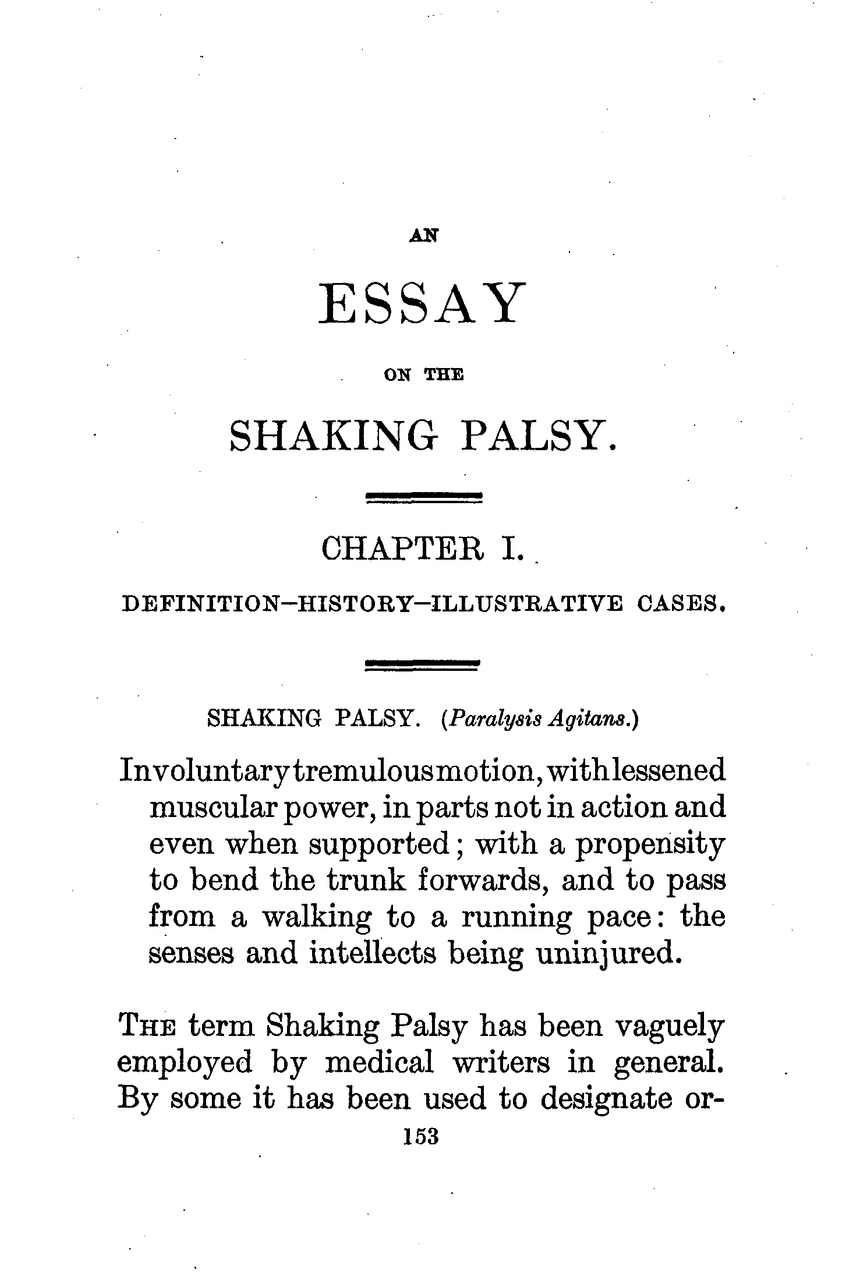 The opening of James Parkinson's An Essay on the Shaking Palsy, London, 1817, with his definition of the diseaseWikimedia Commons, James Parkinson, Public domain (Parkinson, An Essay on the Shaking Palsy (first page).png)
Sources
- Susan Standring (ed.), Gray's Anatomy, 42nd ed. (2020), chapter on the basal ganglia.
- Arthur Guyton and John Hall, Textbook of Medical Physiology, 13th ed. (2016), ch. 57.
- James Parkinson, An Essay on the Shaking Palsy (London, 1817).
Prev: The bridge between the halvesNext: Thalamus and hypothalamus