The brachial plexus
Five spinal nerves, the fifth cervical to the first thoracic, mix in the neck and armpit as the brachial plexus. The five roots join into three trunks. Each trunk splits into a front and a back division, and the divisions regroup into three cords around the axillary artery. The back divisions together form the posterior cord.
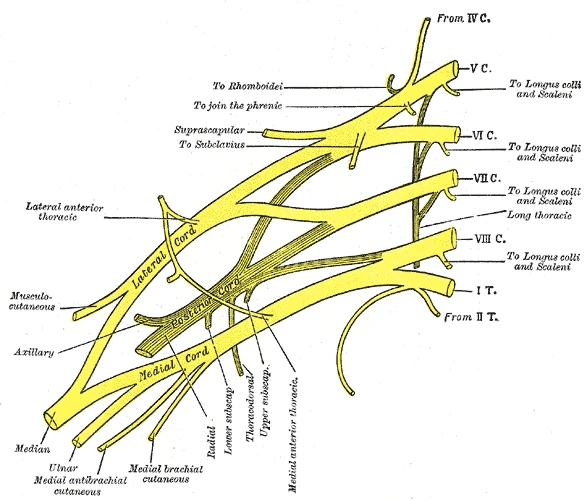 Plan of the brachial plexus: the fifth cervical to first thoracic nerves join into lateral, posterior and medial cords that end in the musculocutaneous, axillary, radial, median and ulnar nerves, Gray's Anatomy, 20th edition, 1918, figure 807Wikimedia Commons, Henry Vandyke Carter, Public domain (Gray807.png)
The cords end in five nerves: the musculocutaneous, axillary, radial, median and ulnar. Each arm muscle therefore receives fibres from more than one cord segment. A hard pull of the head away from the shoulder, as in a difficult birth, can tear the upper trunk and leave the arm hanging and turned in. Erb described this palsy in 1874.
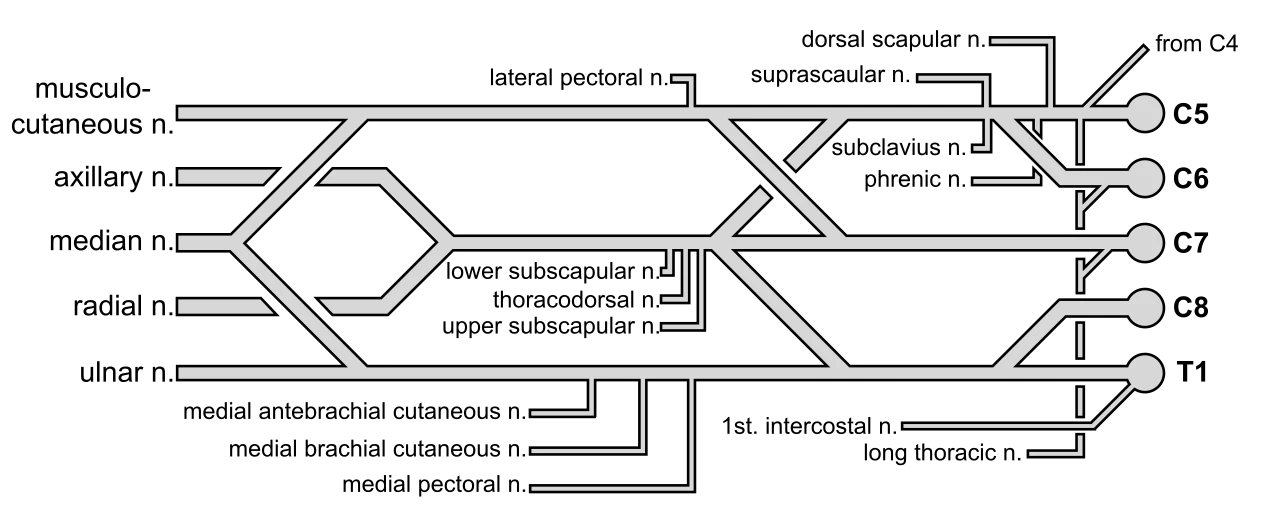 The brachial plexus from its roots, C5 to T1, on the right to its five end nerves on the leftWikimedia Commons, Selket, CC BY-SA 3.0 (Brachial plexus.svg)
Sources
- Susan Standring (ed.), Gray's Anatomy, 42nd ed. (2020), section on the pectoral girdle and upper limb.
- Wilhelm Erb, Über eine eigenthümliche Localisation von Lähmungen im Plexus brachialis, Verhandlungen des naturhistorisch-medicinischen Vereins zu Heidelberg (1874).
Prev: The knee jerkNext: Nerves of the arm