The brainstem
The brainstem joins the brain to the cord. From top to bottom it has three parts. The midbrain carries the cerebral peduncles, the stalks that bring the great motor tracts down from the hemispheres. The pons bulges in front of the cerebellum. The medulla oblongata narrows into the spinal cord at the base of the skull.
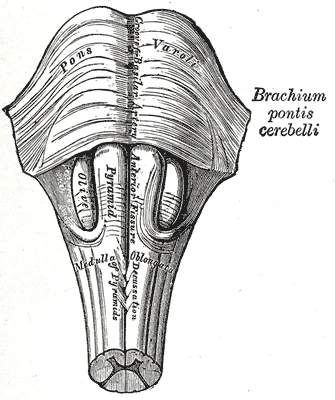 The pons and the medulla oblongata from the front, with the pyramids crossing in the decussation below, Gray's Anatomy, 20th edition, 1918, figure 679Wikimedia Commons, Henry Vandyke Carter, Public domain (Gray679.png)
Ten of the twelve pairs of cranial nerves, from the oculomotor to the hypoglossal, leave the brainstem, and their nuclei lie inside it. The medulla holds the centres that set the rhythm of breathing and the pressure of the blood. This is why an injury to the medulla can stop breathing.
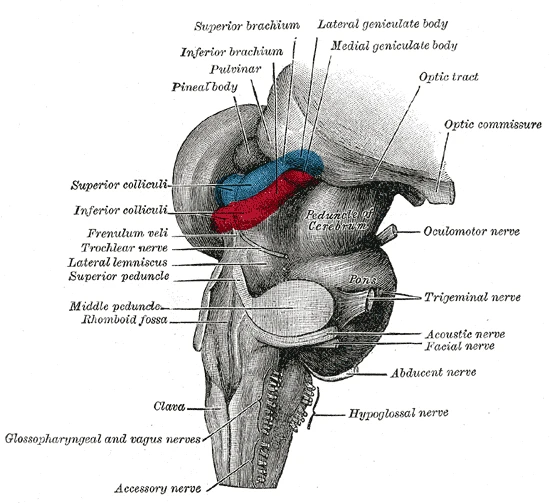 The midbrain, pons and medulla from behind and the side, with the cranial nerves leaving them, Gray's Anatomy, 20th edition, 1918, figure 719Wikimedia Commons, Henry Vandyke Carter, Public domain (Gray719.png)
Sources
- Susan Standring (ed.), Gray's Anatomy, 42nd ed. (2020), chapter on the brainstem.
- Arthur Guyton and John Hall, Textbook of Medical Physiology, 13th ed. (2016), ch. 18 and 42.
Prev: The ventriclesNext: The cerebellum