The cerebellum
Under the back of the hemispheres sits the cerebellum, the little brain. It is about a tenth of the brain's weight, yet it holds about 69 of the brain's 86 billion nerve cells. Most of them are tiny granule cells packed into its thin, finely folded cortex.
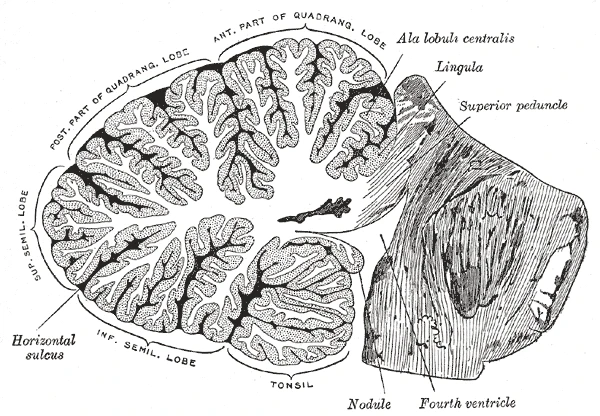 Section through the cerebellum beside the brainstem, showing its thin, deeply folded cortex, Gray's Anatomy, 20th edition, 1918, figure 704Wikimedia Commons, Henry Vandyke Carter, Public domain (Gray704.png)
The cerebellum compares the movement the cortex intends with the movement the body makes, and corrects it while it happens. Damage to it leaves strength intact but makes movements clumsy and shaky on the same side of the body, the walk wide and staggering, and speech slurred. Alcohol does much the same, which is why a drunk person staggers.
Sources
- Susan Standring (ed.), Gray's Anatomy, 42nd ed. (2020), chapter on the cerebellum.
- Arthur Guyton and John Hall, Textbook of Medical Physiology, 13th ed. (2016), ch. 57.
- Frederico Azevedo et al., Equal numbers of neuronal and nonneuronal cells make the human brain an isometrically scaled-up primate brain, Journal of Comparative Neurology 513 (2009): 532-541.
Prev: The brainstemNext: From cortex to cord