Where the cord ends
The cord grows more slowly than the spine. At birth it reaches the third lumbar vertebra, in an adult only the border between the first and second lumbar vertebrae. There it tapers to a point. The nerve roots for the legs and pelvis run on down the canal to their exits, a bundle called the cauda equina, the horse's tail.
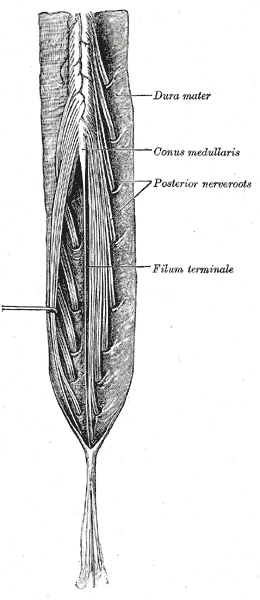 The lower end of the spinal cord and the nerve roots of the cauda equina, seen from behind with the dura opened, Gray's Anatomy, 20th edition, 1918, figure 662Wikimedia Commons, Henry Vandyke Carter, Public domain (Gray662.png)
Below the end of the cord a needle can enter the canal and miss it. In a lumbar puncture the doctor passes a fine needle between the third and fourth lumbar vertebrae and draws off a few millilitres of cerebrospinal fluid. Heinrich Quincke introduced the method in Kiel in 1891.
Sources
- Susan Standring (ed.), Gray's Anatomy, 42nd ed. (2020), chapter on the gross anatomy of the spinal cord and spinal nerves.
- Heinrich Quincke, Die Lumbalpunction des Hydrocephalus, Berliner klinische Wochenschrift 28 (1891): 929-933 and 965-968.
Prev: The cord and its nervesNext: The knee jerk