Twelve cranial nerves
Twelve pairs of nerves leave the brain itself and pass out through holes in the skull. Numbered from front to back they are the olfactory, optic, oculomotor, trochlear, trigeminal, abducens, facial, vestibulocochlear, glossopharyngeal, vagus, accessory and hypoglossal. Some carry only sensation, some only commands to muscles, and several carry both.
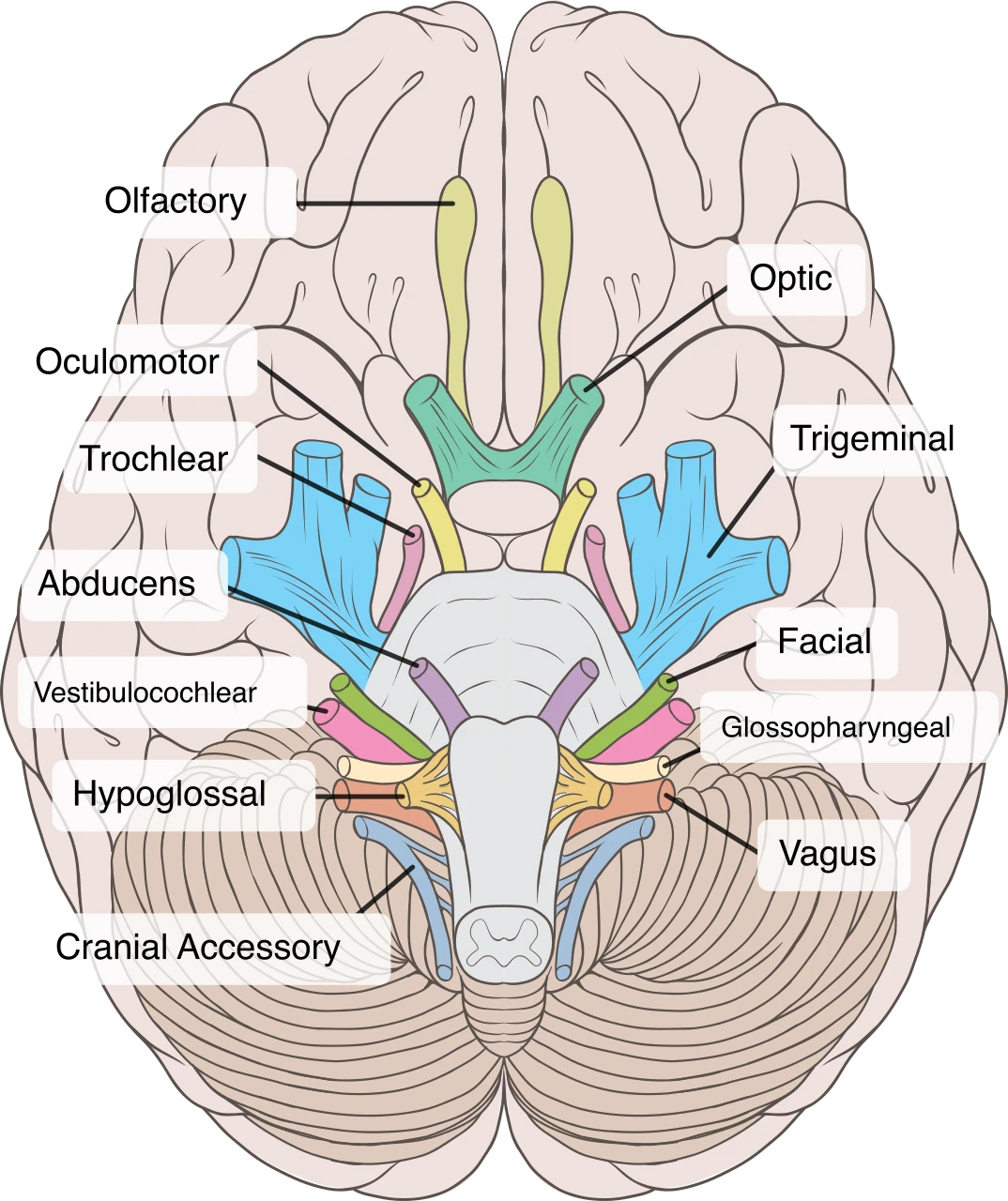 The twelve cranial nerves at the base of the brainWikimedia Commons, Patrick J. Lynch, CC BY 2.5 (Brain human normal inferior view with labels en.svg)
The trigeminal nerve feels the face through three divisions. The ophthalmic reaches the forehead, upper lid, nose and cornea. The maxillary reaches the cheek and upper teeth. The mandibular reaches the jaw, lower teeth and front of the tongue, and works the chewing muscles.
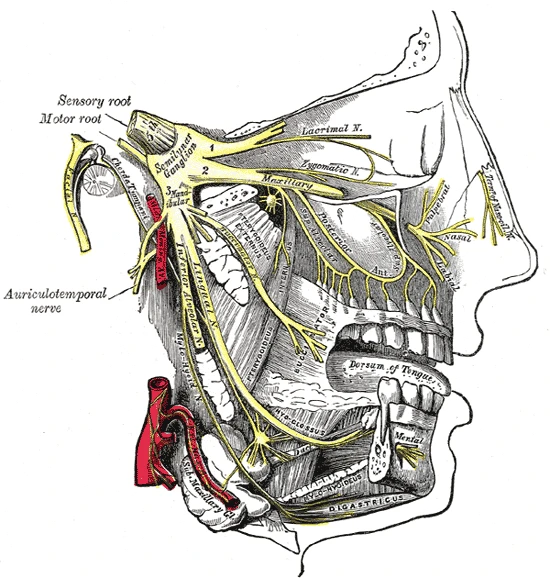 The trigeminal nerve: from the semilunar ganglion the maxillary and mandibular divisions spread to the cheek, teeth, jaw and tongue, Gray's Anatomy, 20th edition, 1918, figure 778Wikimedia Commons, Henry Vandyke Carter, Public domain (Gray778.png)
A touch on the cornea makes both eyes blink: the ophthalmic nerve carries the touch in and the facial nerve closes the lids.
Sources
- Susan Standring (ed.), Gray's Anatomy, 42nd ed. (2020), chapter on the brainstem.
- Susan Standring (ed.), Gray's Anatomy, 42nd ed. (2020), chapter on the orbit and accessory visual apparatus.
Prev: Moving the eyeNext: Two systems