Moving the eye
Six muscles turn each eye, four straight recti and two obliques, and a seventh lifts the upper lid. Three cranial nerves work them. The oculomotor nerve supplies five of them: the superior, inferior and medial recti, the inferior oblique and the lid lifter.
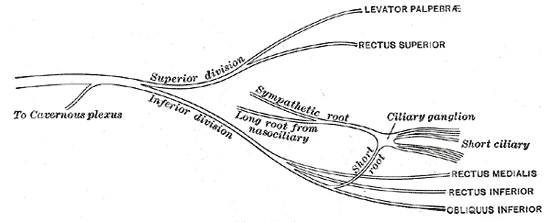 Plan of the oculomotor nerve: its two divisions reach the lid lifter, the superior, medial and inferior recti and the inferior oblique, and a short root joins the ciliary ganglion, Gray's Anatomy, 20th edition, 1918, figure 775Wikimedia Commons, Henry Vandyke Carter, Public domain (Gray775.png)
The thin trochlear nerve, the only cranial nerve that leaves the back of the brainstem, supplies the superior oblique, whose tendon runs through a pulley of cartilage. The abducens nerve supplies the lateral rectus, which turns the eye outward. A palsy of any of the three throws the eyes out of line, and the person sees double.
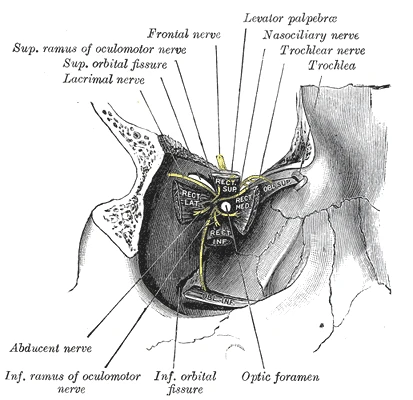 The origins of the eye muscles at the back of the right orbit, with the oculomotor, trochlear and abducent nerves entering, Gray's Anatomy, 20th edition, 1918, figure 787Wikimedia Commons, Henry Vandyke Carter, Public domain (Gray787.png)
Sources
- Susan Standring (ed.), Gray's Anatomy, 42nd ed. (2020), chapter on the orbit and accessory visual apparatus.
- Susan Standring (ed.), Gray's Anatomy, 42nd ed. (2020), chapter on the brainstem.
Prev: From eye to cortexNext: Twelve cranial nerves