Galvani's frogs
In the 1780s Luigi Galvani, a professor of anatomy in Bologna, cut frogs down to their lower spine and legs, joined only by the nerves of the legs. When a brass hook through the spinal cord touched an iron railing, the legs twitched. An arc of two metals laid from nerve to muscle did the same.
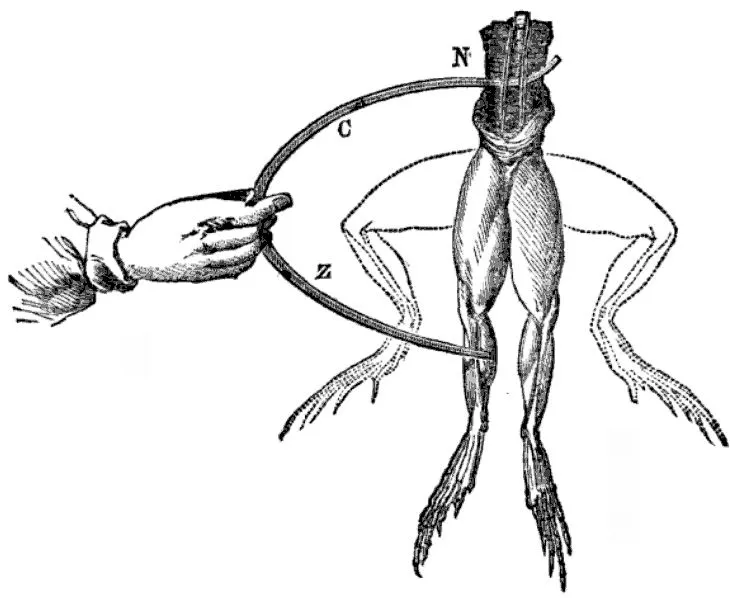 Frog legs, joined to the spinal cord by their nerves, twitching when an arc of copper and zinc touches nerve and muscle, from David Ames Wells' The Science of Common Things, 1859Wikimedia Commons, David Ames Wells, Public domain (Galvani-frogs-legs-electricity.jpg)
In 1791 Galvani concluded that nerve and muscle carry an electricity of their own, which the metals only released. Alessandro Volta replied that the current came from the two metals, and to prove it he built the first battery in 1800. Both were partly right: the metals had made the current, and nerves do run on electricity.
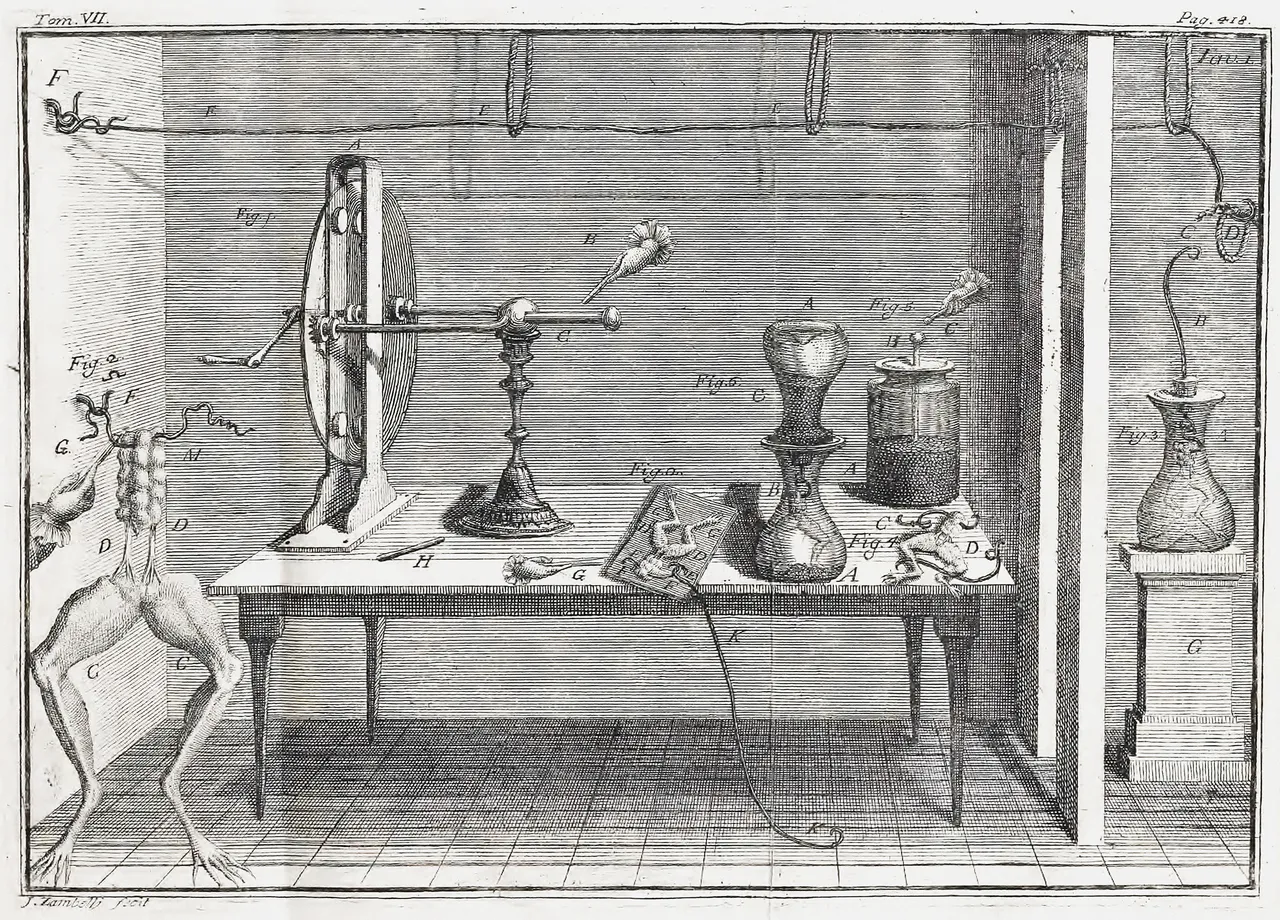 Plate 1 of Galvani's De viribus electricitatis in motu musculari, Bologna, 1791: prepared frog legs beside an electrical machineWikimedia Commons, Luigi Galvani, Public domain (Luigi Galvani Experiment.jpeg)
Sources
- Luigi Galvani, De viribus electricitatis in motu musculari commentarius (Bologna, 1791).
- Alessandro Volta, On the electricity excited by the mere contact of conducting substances of different kinds, Philosophical Transactions of the Royal Society 90 (1800): 403-431.
Prev: The signalNext: Broca's patient