Two hemispheres
Seen from above, the brain is two halves side by side, the left hemisphere and the right hemisphere, with a deep cleft between them. A folded sheet of grey matter 2 to 4 millimetres thick, the cortex, covers each one. About two thirds of it lies hidden in the grooves between the folds.
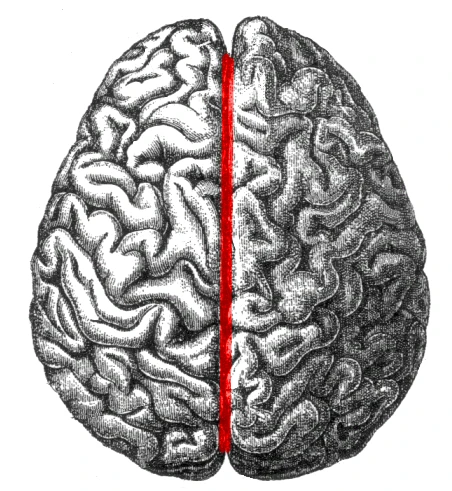 The brain from above, with the longitudinal fissure between the two hemispheres marked in red, from Gray's AnatomyWikimedia Commons, Gray's Anatomy, Public domain (Human brain longitudinal fissure.png)
Each hemisphere moves and feels the opposite half of the body. The nerve fibres cross to the other side on their way down to the cord and on their way up from it, so a stroke in the left hemisphere weakens the right arm and the right leg.
The two halves look alike but share the work unequally. In about 95 per cent of right-handed people, language sits in the left hemisphere.
Sources
- Susan Standring (ed.), Gray's Anatomy, 42nd ed. (2020), chapter on the cerebral hemispheres.
- Theodore Rasmussen and Brenda Milner, The role of early left-brain injury in determining lateralization of cerebral speech functions, Annals of the New York Academy of Sciences 299 (1977): 355-369.
Prev: Brain, cord and nervesNext: Four lobes