Language
Two areas of the left hemisphere carry most of the work of language. Broca's area, in the back of the inferior frontal gyrus, turns words into speech. A person with damage there understands, but speaks slowly in short, broken phrases.
Wernicke's area, at the back of the superior temporal gyrus next to the hearing cortex, gives words their meaning. With damage there, speech flows but is empty or garbled, and the person does not follow what is said to them. A bundle of fibres, the arcuate fasciculus, links the two areas.
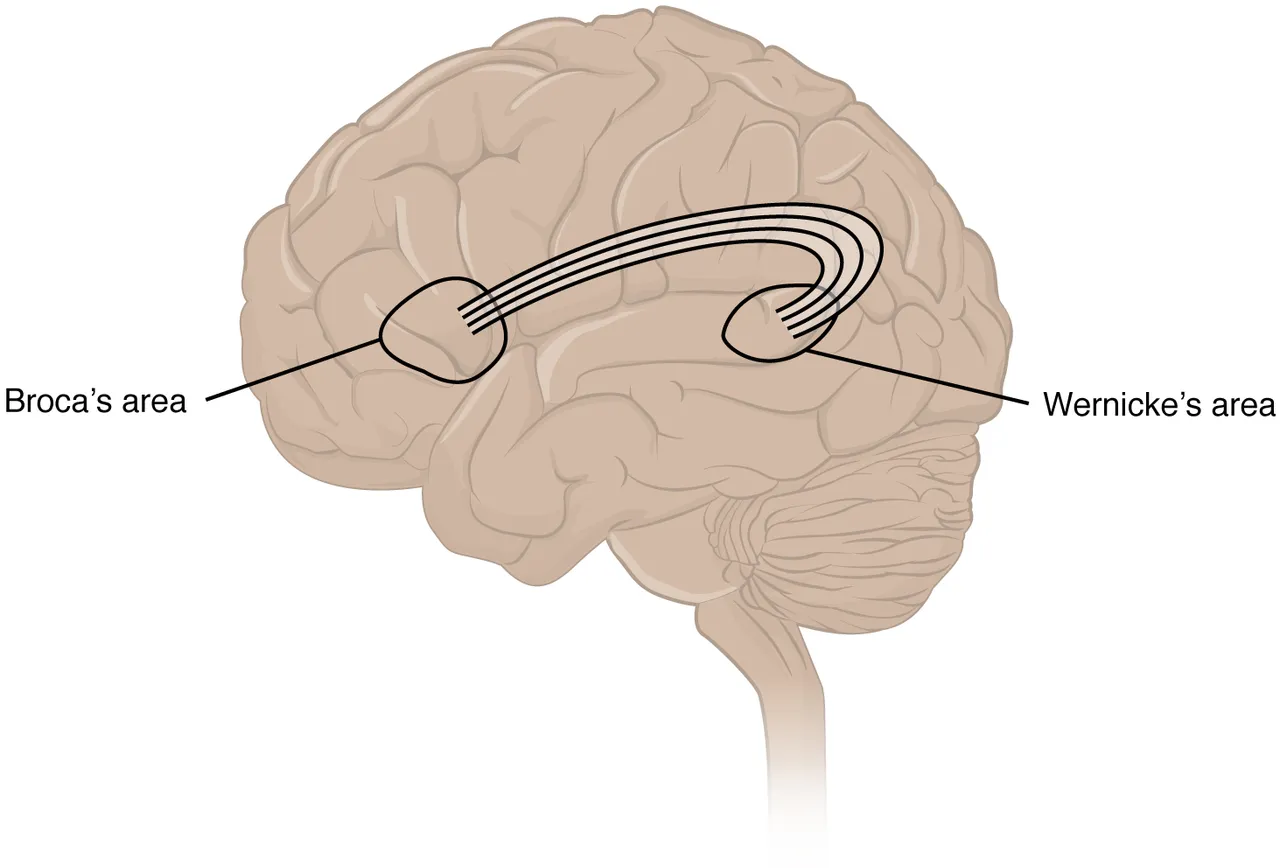 Broca's area in the frontal lobe and Wernicke's area in the temporal lobe, joined by the arcuate fasciculusWikimedia Commons, OpenStax College, CC BY 3.0 (1605 Brocas and Wernickes Areas-02.jpg)
Carl Wernicke described the second area in 1874, at the age of 26, from patients who spoke fluently and made no sense.
Sources
- Susan Standring (ed.), Gray's Anatomy, 42nd ed. (2020), chapter on the cerebral hemispheres.
- Arthur Guyton and John Hall, Textbook of Medical Physiology, 13th ed. (2016), ch. 58.
- Carl Wernicke, Der aphasische Symptomencomplex (Breslau, 1874).
Prev: Movement and touchNext: Grey and white matter