Four lobes
Two deep grooves divide each hemisphere into four lobes, named after the skull bones above them. The central sulcus separates the frontal lobe in front from the parietal lobe behind it. The lateral sulcus runs back along the side and separates both from the temporal lobe below. The occipital lobe forms the back.
 The left hemisphere from the side, with the frontal, parietal, temporal and occipital lobes coloured, Gray's Anatomy, 20th edition, 1918, figure 728Wikimedia Commons, Henry Vandyke Carter, vectorised by Mysid, Public domain (Gray728.svg)
The frontal lobe plans and starts movement and holds back impulses. The parietal lobe receives touch and maps the body in space. The temporal lobe hears and stores memories, and the occipital lobe sees. A fifth lobe, the insula, lies folded inside the lateral sulcus.
In 1848 an iron rod 1.1 metres long shot through the front of the brain of Phineas Gage, a railway foreman in Vermont. He survived and could walk, talk and remember, but his doctor reported that his friends found him "no longer Gage": impatient, rude and unable to keep to a plan.
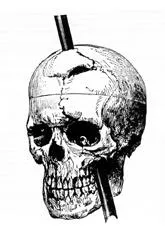 The path of the iron rod through the skull of Phineas Gage, from John Harlow's report of 1868Wikimedia Commons, John M. Harlow, Public domain (Phineas gage - 1868 skull diagram.jpg)
Sources
- Susan Standring (ed.), Gray's Anatomy, 42nd ed. (2020), chapter on the cerebral hemispheres.
- John M. Harlow, Recovery from the passage of an iron bar through the head, Publications of the Massachusetts Medical Society 2 (1868): 327-347.
Prev: Two hemispheresNext: Movement and touch