Memory
Curled in the floor of each temporal lobe lies the hippocampus, named for its seahorse shape. It turns the events of the day into lasting memories, which then settle across the cortex. Its output runs forward in an arching bundle, the fornix. In front of it sits the amygdala, an almond of grey matter that tags events with fear.
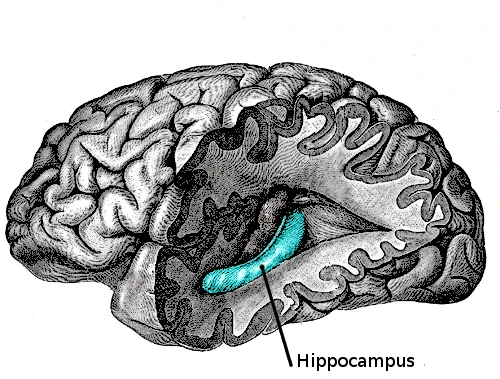 The hippocampus, coloured, in the floor of the opened inferior horn of the left lateral ventricle, after Gray's Anatomy, 20th edition, 1918, figure 739Wikimedia Commons, Henry Vandyke Carter, Public domain (Gray739-emphasizing-hippocampus.png)
In 1953 the surgeon William Scoville removed most of the hippocampus and the amygdala on both sides from Henry Molaison, aged 27, to stop his seizures. The seizures eased, but from then on he could not form a new lasting memory. He kept his old memories and learned new skills, such as drawing in a mirror, without remembering the practice.
Sources
- Susan Standring (ed.), Gray's Anatomy, 42nd ed. (2020), chapter on the cerebral hemispheres.
- Arthur Guyton and John Hall, Textbook of Medical Physiology, 13th ed. (2016), ch. 58 and 59.
- William Beecher Scoville and Brenda Milner, Loss of recent memory after bilateral hippocampal lesions, Journal of Neurology, Neurosurgery and Psychiatry 20 (1957): 11-21.
Prev: Thalamus and hypothalamusNext: The ventricles