Movement and touch
On either side of the central sulcus runs a strip of cortex that holds a map of the body. The precentral gyrus, in front, sends the commands that move the muscles. The postcentral gyrus, behind, receives touch, pressure and pain. In both, the feet lie at the top near the midline and the face lies low on the side.
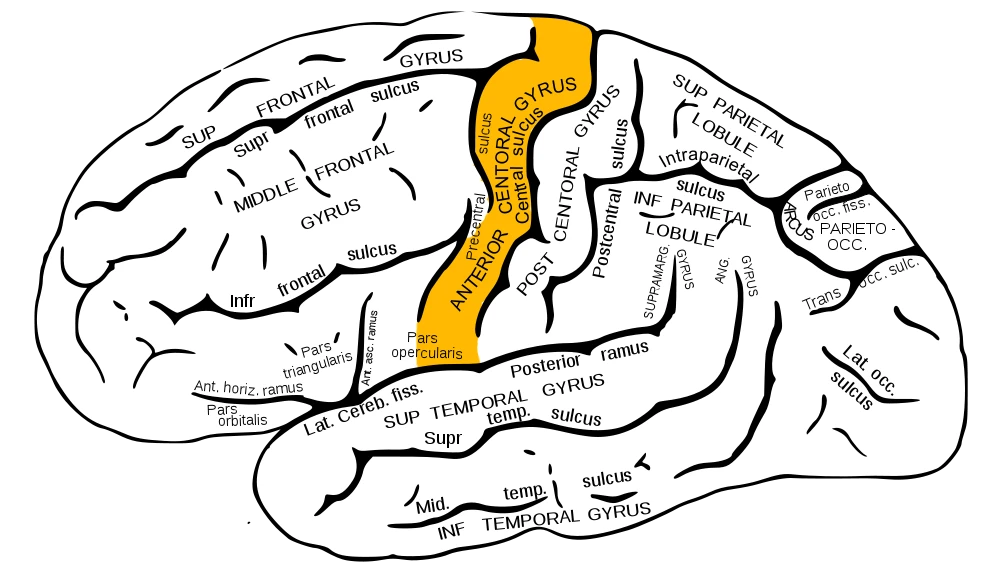 The precentral gyrus, coloured, in front of the central sulcus of the left hemisphere, after Gray's Anatomy, 20th edition, 1918, figure 726Wikimedia Commons, Henry Vandyke Carter, vectorised by Mysid, coloured by was_a_bee, Public domain (Gray726 precentral gyrus.png)
The map is out of proportion. The hands, lips and tongue take far more cortex than the back or the thigh, because they move finely and feel finely. Drawn to that scale the body becomes the homunculus, the little man that Wilder Penfield and Edwin Boldrey published in 1937 after stimulating the cortex of awake patients during surgery for epilepsy.
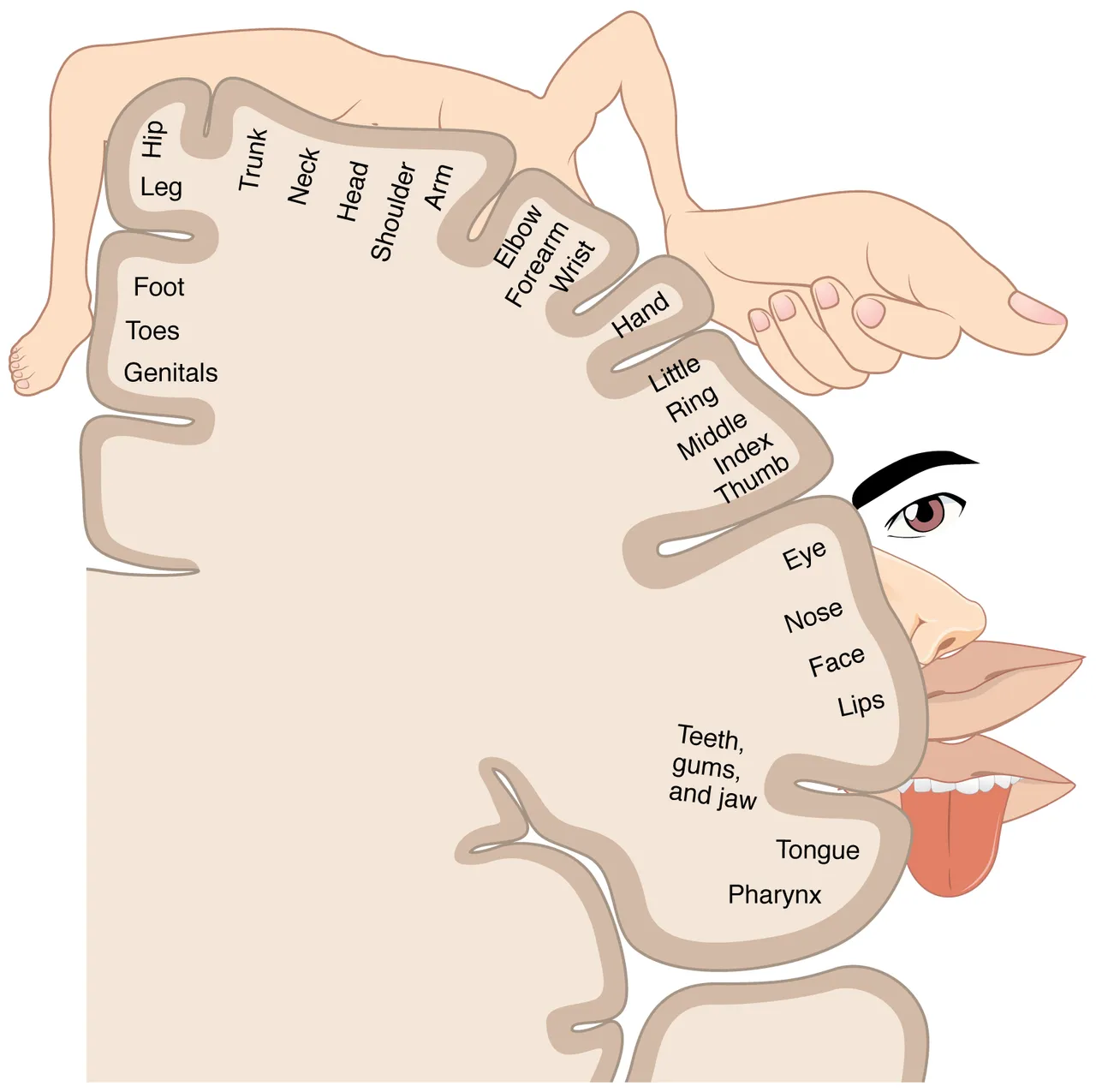 The sensory homunculus: the body mapped onto the postcentral gyrus of one hemisphere, with the hand, lips and tongue drawn largeWikimedia Commons, OpenStax College, CC BY 3.0 (1421 Sensory Homunculus.jpg)
Sources
- Susan Standring (ed.), Gray's Anatomy, 42nd ed. (2020), chapter on the cerebral hemispheres.
- Arthur Guyton and John Hall, Textbook of Medical Physiology, 13th ed. (2016), ch. 48 and 56.
- Wilder Penfield and Edwin Boldrey, Somatic motor and sensory representation in the cerebral cortex of man as studied by electrical stimulation, Brain 60 (1937): 389-443.
Prev: Four lobesNext: Language