From eye to cortex
The two optic nerves leave the back of the eyes and meet under the brain at the optic chiasm, just in front of the pituitary. There the fibres from the inner half of each retina cross to the other side. Each optic tract behind the chiasm therefore carries one half, left or right, of what both eyes see.
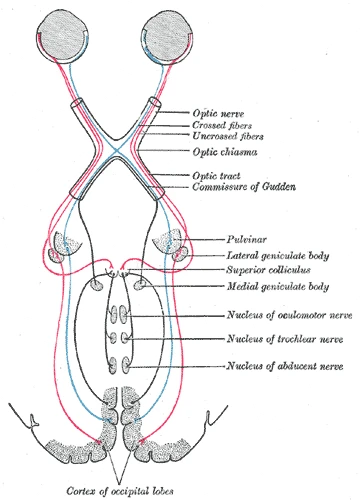 The visual pathway: fibres from the inner half of each retina cross in the optic chiasma and reach the cortex of the occipital lobes through the lateral geniculate bodies, Gray's Anatomy, 20th edition, 1918, figure 722Wikimedia Commons, Henry Vandyke Carter, Public domain (Gray722.png)
Each tract ends in a relay of the thalamus, the lateral geniculate body. From there a broad band of fibres, the optic radiation, fans back to the visual cortex in the occipital lobe. A stroke in the right occipital lobe blinds the left half of the field of view of both eyes.
In his Treatise of Man, printed in 1664, René Descartes drew the path as tubes from the eyes to the pineal gland, which he took for the seat of the soul.
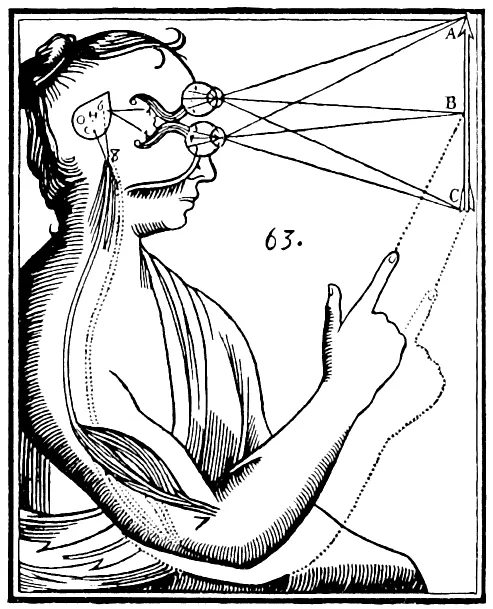 René Descartes' drawing of vision in the Treatise of Man, 1664: the optic nerves run from the eyes to the pineal glandWikimedia Commons, René Descartes, Public domain (Descartes mind and body.gif)
Sources
- Susan Standring (ed.), Gray's Anatomy, 42nd ed. (2020), chapters on the diencephalon and on the cerebral hemispheres.
- Arthur Guyton and John Hall, Textbook of Medical Physiology, 13th ed. (2016), ch. 52.
- René Descartes, L'Homme (Paris, 1664).
Prev: The eyeNext: Moving the eye