The pupil
Shine a light into one eye and both pupils narrow within a second. The signal runs from the retina to the midbrain and back out in the oculomotor nerves to the ciliary ganglion, a parasympathetic relay 2 millimetres long behind the eye. From there the short ciliary nerves reach the ring muscle of the iris.
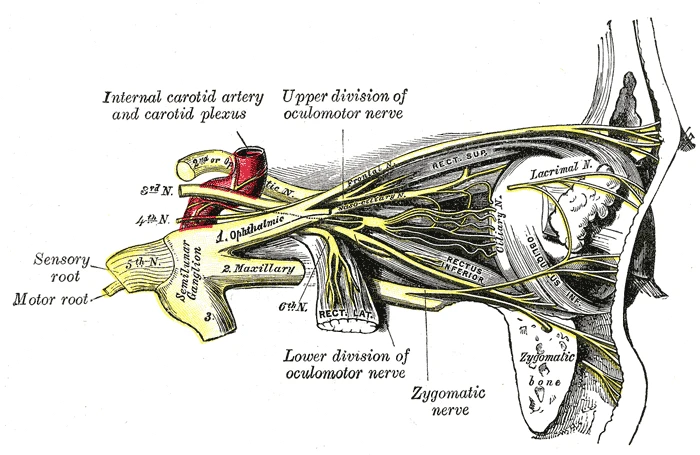 The nerves of the orbit and the ciliary ganglion, side view, Gray's Anatomy, 20th edition, 1918, figure 777Wikimedia Commons, Henry Vandyke Carter, Public domain (Gray777.png)
In the dark, or in fright, sympathetic fibres from the upper chest segments of the cord pull the pupil wide through a second, radial muscle. The pupil ranges from about 1.5 to 8 millimetres. Doctors shine a torch into the eyes of an unconscious patient because the reflex tests the midbrain itself.
Tears are parasympathetic too: fibres of the facial nerve reach the lacrimal gland above the outer corner of the eye.
Sources
- Arthur Guyton and John Hall, Textbook of Medical Physiology, 13th ed. (2016), ch. 52 and 61.
- Susan Standring (ed.), Gray's Anatomy, 42nd ed. (2020), chapter on the orbit and accessory visual apparatus.
Prev: The vagusNext: The neuron