The eye
The eyeball is about 24 millimetres across. Light enters through the clear cornea, which does about two thirds of the focusing, passes the hole in the coloured iris, the pupil, and is focused by the lens onto the retina at the back. Muscles round the lens let it round up for near things and flatten for far ones.
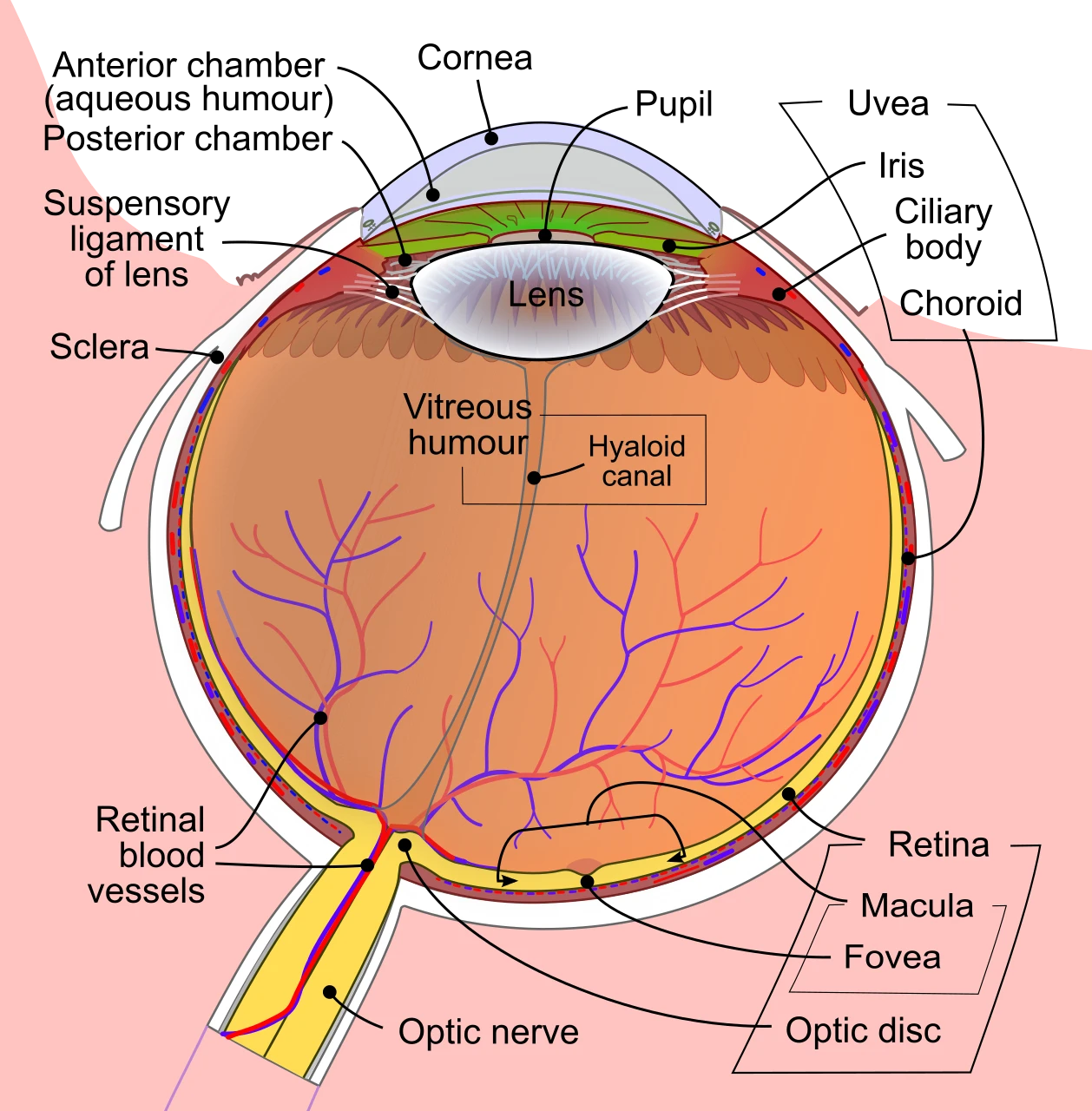 Horizontal section through the eye, with the cornea, iris, lens, retina and optic nerveWikimedia Commons, Rhcastilhos and Jmarchn, CC BY-SA 3.0 (Schematic diagram of the human eye en.svg)
The retina is a thin sheet of brain pushed out into the eye during development. Its light-sensitive cells, about 100 million rods for dim light and 3 million cones for colour and detail, report through bipolar cells to 1.6 million ganglion cells. The axons of the ganglion cells form the optic nerve.
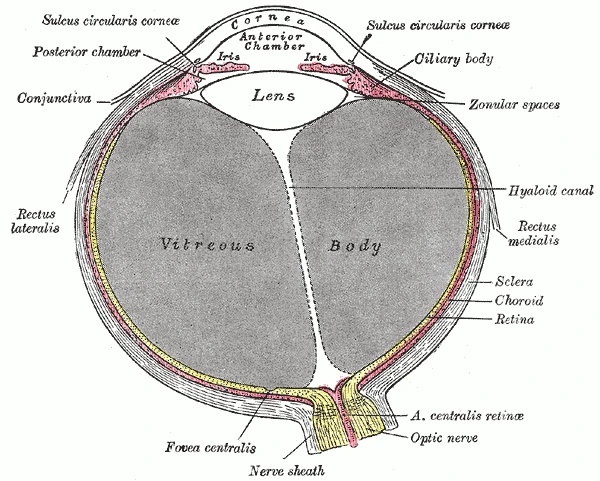 Horizontal section of the eyeball: the retina lines its back, and the optic nerve leaves it, Gray's Anatomy, 20th edition, 1918, figure 869Wikimedia Commons, Henry Vandyke Carter, Public domain (Gray869.png)
Sources
- Susan Standring (ed.), Gray's Anatomy, 42nd ed. (2020), chapter on the eye.
- Arthur Guyton and John Hall, Textbook of Medical Physiology, 13th ed. (2016), ch. 50 and 51.
Prev: Nerves of the legNext: From eye to cortex