The neuron
A nerve cell, or neuron, has three parts. The cell body holds the nucleus. Branching dendrites take in signals, through up to 200,000 contacts on a single motor neuron. One long axon sends the cell's own signal away, sometimes a metre. The grey matter of the cortex is packed with cell bodies and dendrites, the white matter with axons.
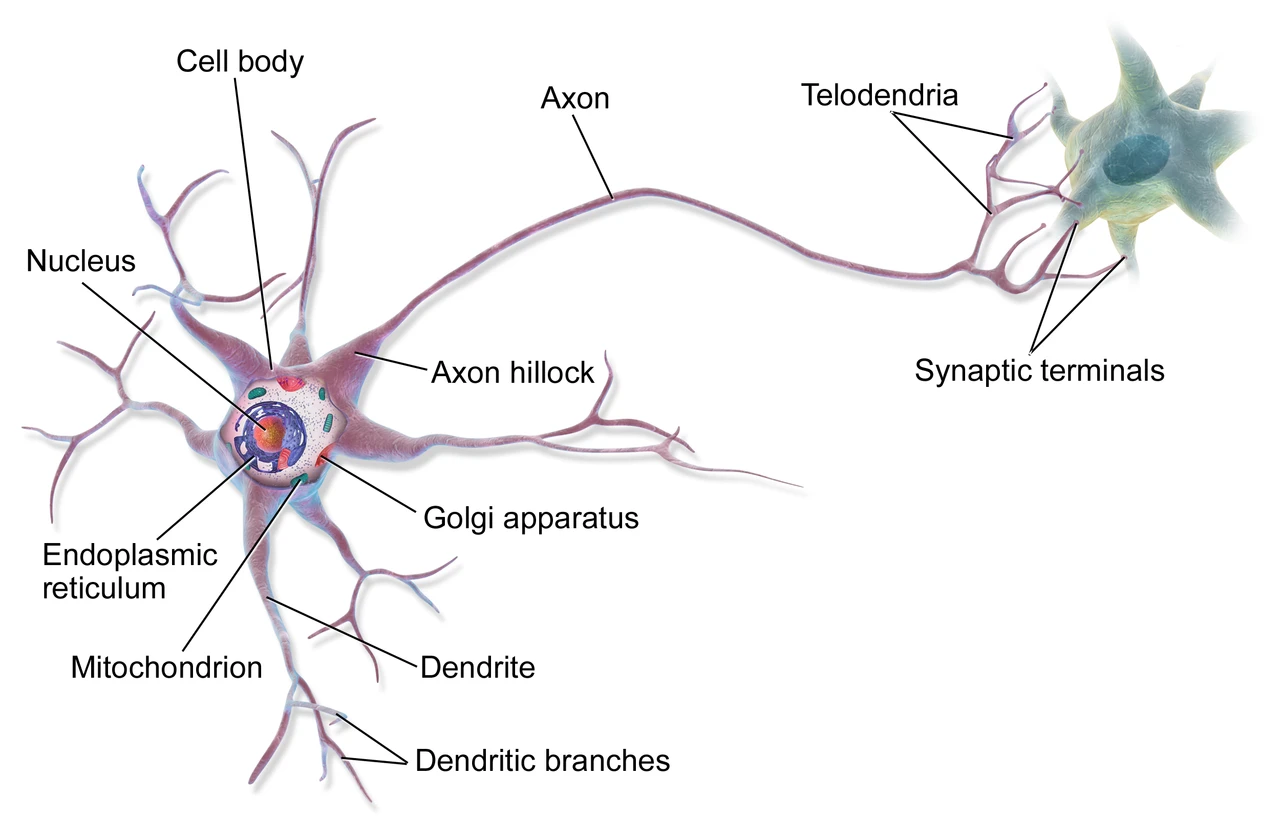 A neuron: the cell body with its nucleus, branching dendrites, and an axon ending in synaptic terminals on the next cellWikimedia Commons, BruceBlaus, CC BY 3.0 (Blausen 0657 MultipolarNeuron.png)
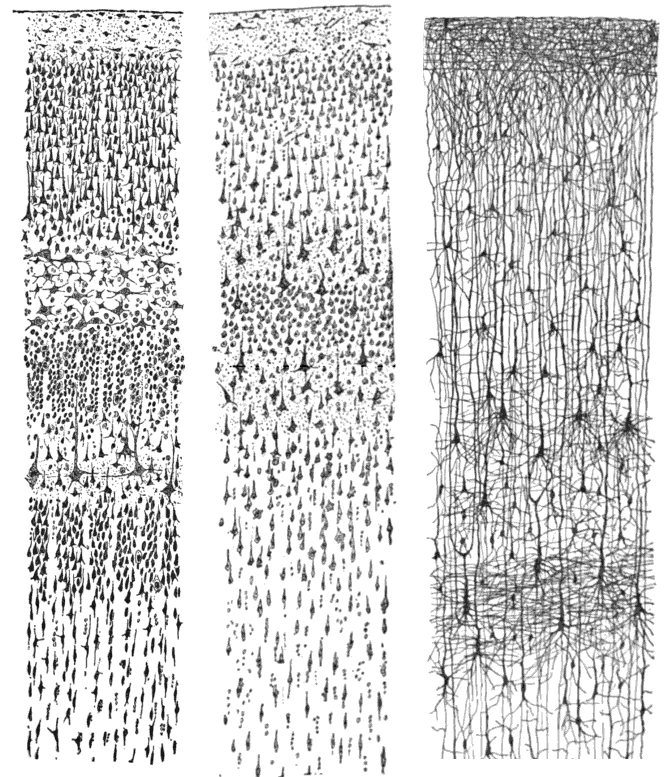 Three drawings of the human cerebral cortex by Santiago Ramón y Cajal, 1899: visual and motor cortex stained for cell bodies, and an infant's cortex stained with Golgi's methodWikimedia Commons, Santiago Ramón y Cajal, Public domain (Cajal cortex drawings.png)
The brain holds about as many supporting glial cells as neurons, some 85 billion. Some wrap axons in myelin, some feed the neurons and clear away their waste, and some act as the brain's immune cells.
Sources
- Susan Standring (ed.), Gray's Anatomy, 42nd ed. (2020), chapter on the tissues of the nervous system.
- Arthur Guyton and John Hall, Textbook of Medical Physiology, 13th ed. (2016), ch. 46.
- Frederico Azevedo et al., Equal numbers of neuronal and nonneuronal cells make the human brain an isometrically scaled-up primate brain, Journal of Comparative Neurology 513 (2009): 532-541.
Prev: The pupilNext: The signal