The signal
At rest the inside of a nerve cell is 60 to 90 millivolts negative, held by pumps that move sodium out and potassium in. A stimulus past threshold opens sodium channels, sodium floods in and the inside swings to 30 or 40 millivolts positive. Within a millisecond potassium flows out and the voltage falls. This spike is the action potential.
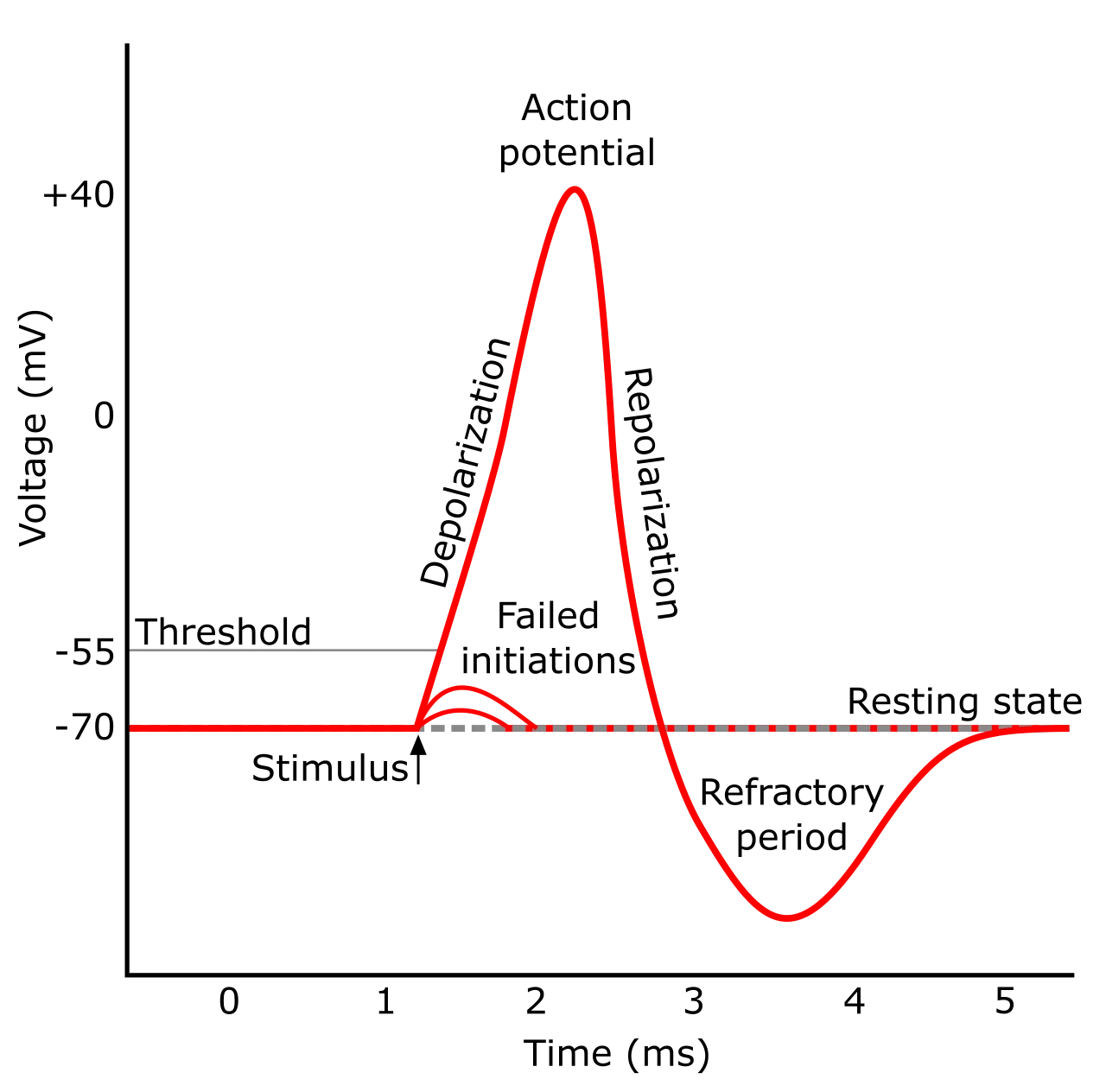 An action potential: a stimulus past the threshold sets off a spike that rises and falls within a few millisecondsWikimedia Commons, Chris 73, Diberri and tiZom, CC BY-SA 3.0 (Action potential.svg)
The spike spreads by triggering the membrane next to it. Bare fibres carry it at as little as 0.25 metres a second. In fibres wrapped in myelin it jumps between gaps 1 to 3 millimetres apart, the nodes of Ranvier, at up to 100 metres a second. The white matter holds 150,000 to 180,000 kilometres of such fibres.
At the end of the axon the signal crosses to the next cell as a chemical. The spike opens calcium channels, and small vesicles release a transmitter into a cleft 20 to 30 nanometres wide. The crossing takes about half a millisecond.
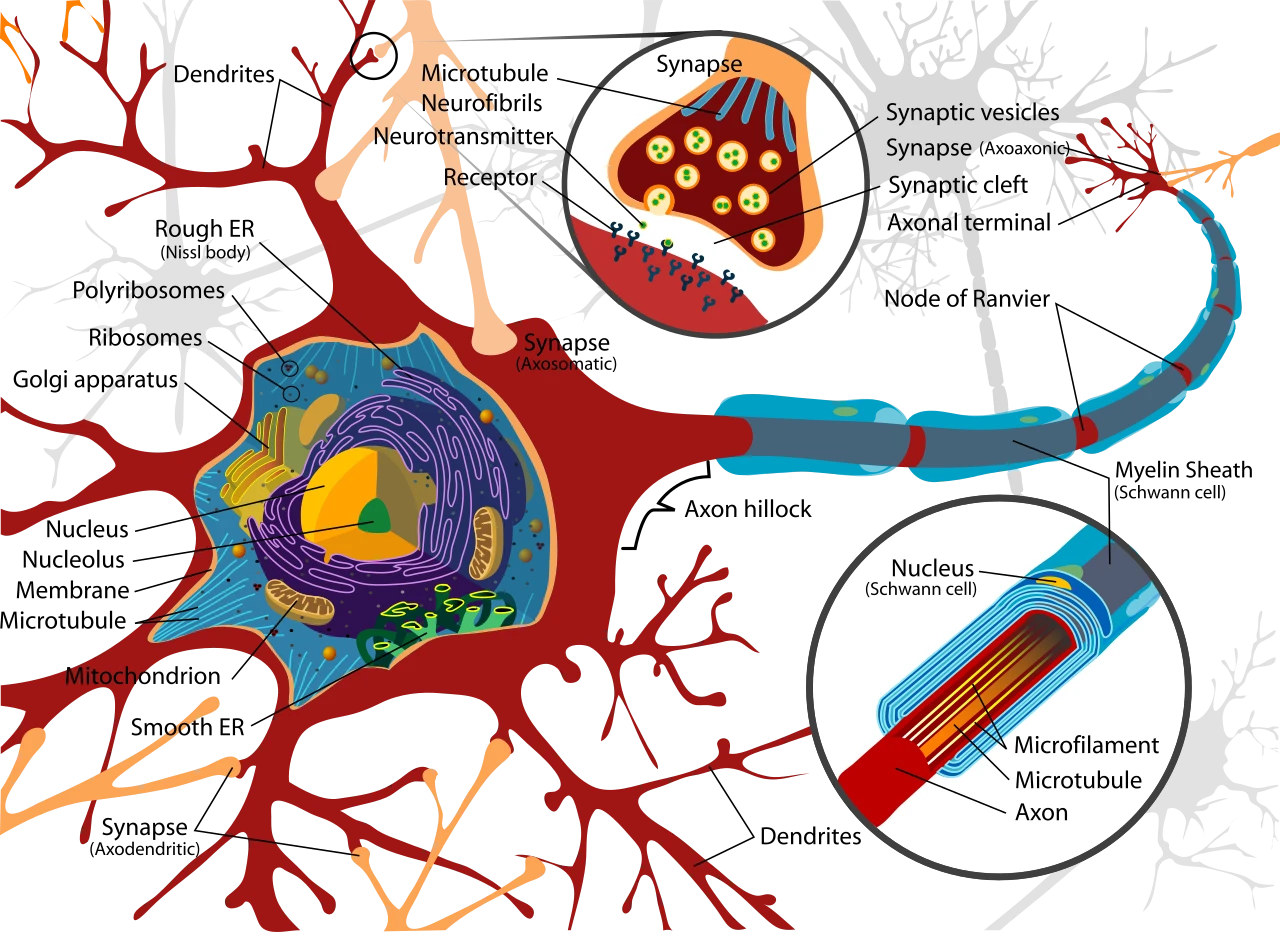 A neuron in detail: the axon wrapped in myelin with nodes of Ranvier, and a synapse with vesicles of transmitter at the cleftWikimedia Commons, LadyofHats, Public domain (Complete neuron cell diagram en.svg)
Sources
- Arthur Guyton and John Hall, Textbook of Medical Physiology, 13th ed. (2016), ch. 5 and 46.
- Lisbeth Marner et al., Marked loss of myelinated nerve fibers in the human brain with age, Journal of Comparative Neurology 462 (2003): 144-152.
Prev: The neuronNext: Galvani's frogs