Brain, cord and nerves
The nervous system has two parts. The central part is the brain inside the skull and the spinal cord inside the spine. The peripheral part is the nerves: 12 pairs leave the brain and 31 pairs leave the cord, and between them they reach every muscle, gland and patch of skin.
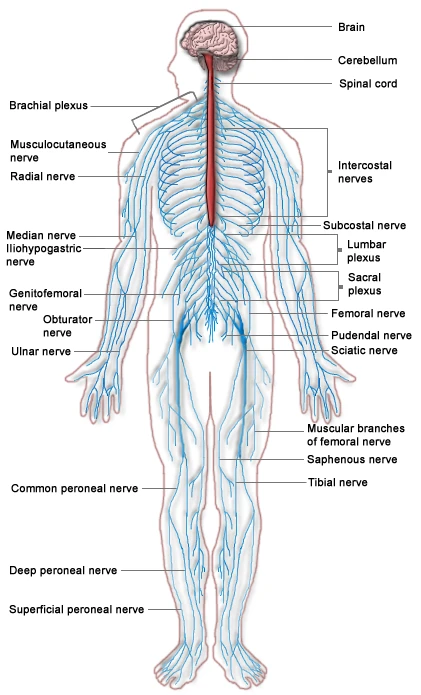 The brain, the spinal cord and the main nerves of the body, from the brachial plexus to the nerves of the feetWikimedia Commons, Persian Poet Gal, Public domain (Nervous system diagram.png)
An adult brain weighs about 1.4 kilograms, some 2 per cent of the body, and holds about 86 billion nerve cells. At rest it uses about 15 per cent of the body's energy and receives 750 to 900 millilitres of blood a minute. When that flow stops, consciousness is lost within 5 to 10 seconds.
Sources
- Susan Standring (ed.), Gray's Anatomy, 42nd ed. (2020), chapter on the overview of the nervous system.
- Arthur Guyton and John Hall, Textbook of Medical Physiology, 13th ed. (2016), ch. 46 and 62.
- Frederico Azevedo et al., Equal numbers of neuronal and nonneuronal cells make the human brain an isometrically scaled-up primate brain, Journal of Comparative Neurology 513 (2009): 532-541.
Next: Two hemispheres