Two systems
A second set of nerves runs the organs without our asking. Its sympathetic half leaves the cord between the first thoracic and second lumbar segments and relays in two chains of ganglia beside the spine. Readying the body for effort, it speeds the heart, widens airways and pupils, pulls sugar from the liver and makes the adrenal glands release adrenaline.
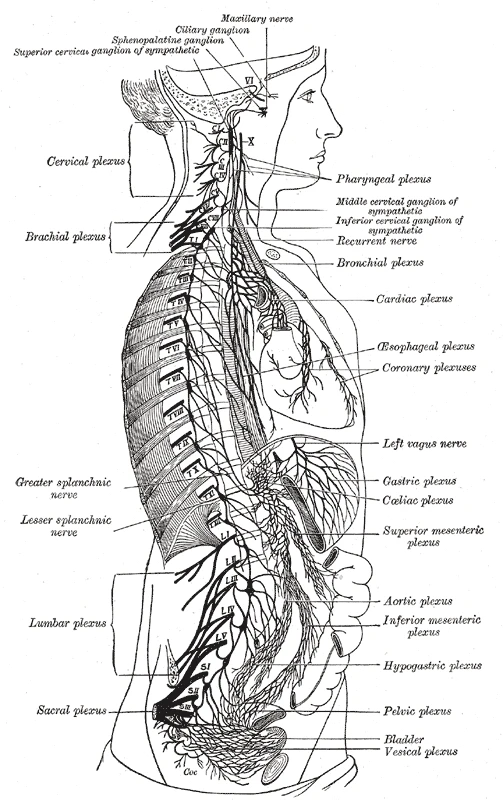 The right sympathetic chain beside the spine and its connections to the plexuses of the chest, abdomen and pelvis, after Schwalbe, Gray's Anatomy, 20th edition, 1918, figure 838Wikimedia Commons, Henry Vandyke Carter, Public domain (Gray838.png)
The parasympathetic half leaves the brainstem in four cranial nerves and the cord in its sacral segments. It slows the heart, drives digestion in the stomach and gut, and empties the urinary bladder. Most organs receive both halves, and the balance between them sets how fast the heart beats or the gut moves.
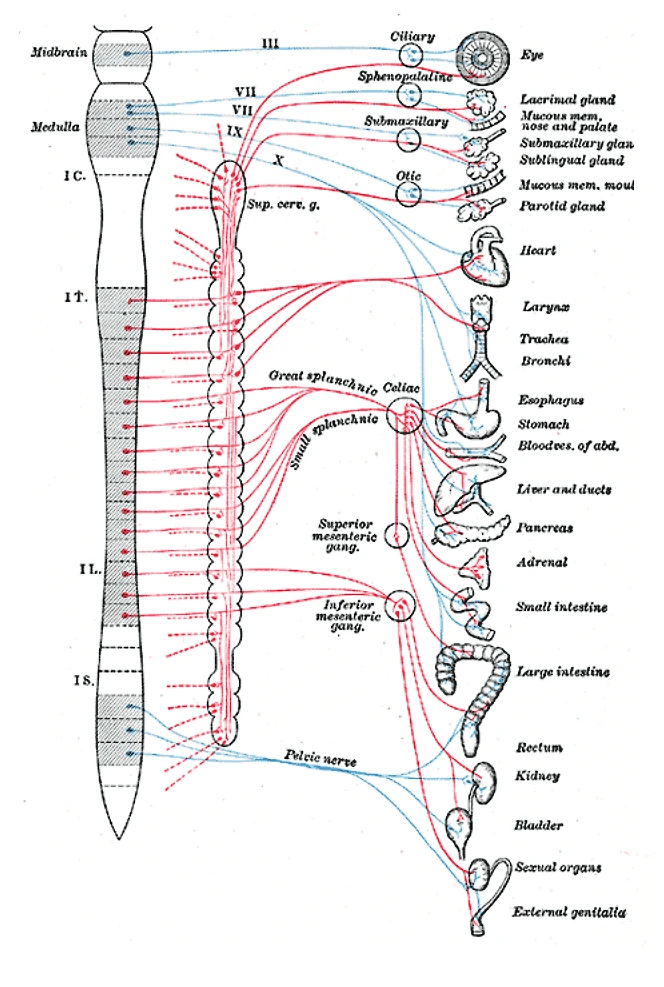 Plan of the sympathetic (red) and parasympathetic (blue) outflow from the brainstem and cord to the organs, Gray's Anatomy, 20th edition, 1918, figure 839Wikimedia Commons, Henry Vandyke Carter, Public domain (Gray839.png)
Sources
- Arthur Guyton and John Hall, Textbook of Medical Physiology, 13th ed. (2016), ch. 61.
- Susan Standring (ed.), Gray's Anatomy, 42nd ed. (2020), chapter on the overview of the nervous system.
Prev: Twelve cranial nervesNext: The vagus