The vagus
The vagus nerve, the tenth cranial nerve, leaves the medulla and wanders further than any other, which gave it its Latin name. It runs down the neck beside the carotid artery, through the chest past the heart and lungs, and along the oesophagus to the stomach and the gut as far as the colon.
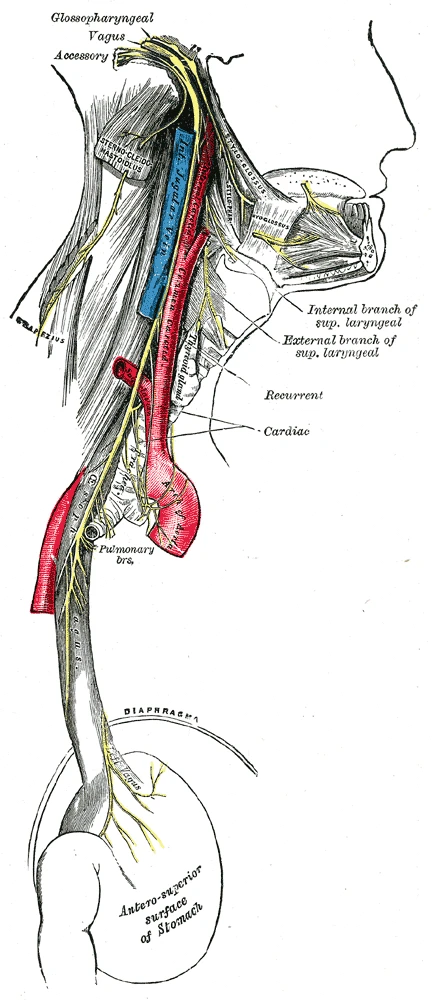 Course of the glossopharyngeal, vagus and accessory nerves: the vagus runs down the neck beside the carotid artery and jugular vein, past the heart and lungs to the stomach, Gray's Anatomy, 20th edition, 1918, figure 793Wikimedia Commons, Henry Vandyke Carter, Public domain (Gray793.png)
About three quarters of all parasympathetic fibres run in the two vagus nerves. Most of the vagus fibres carry news the other way, about four in five: they tell the brainstem how stretched, how acid or how full the organs are.
In 1921 Otto Loewi stimulated the vagus of a frog heart and moved the fluid around it to a second heart, which slowed as well. The nerve had released a chemical, later identified as acetylcholine.
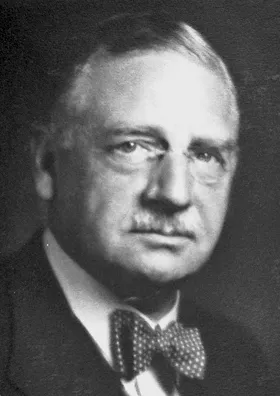 Otto Loewi, who shared the 1936 Nobel Prize in Physiology or Medicine for the chemical transmission of nerve impulsesWikimedia Commons, Albert Hilscher, Public domain (Otto Loewi nobel.jpg)
Sources
- Arthur Guyton and John Hall, Textbook of Medical Physiology, 13th ed. (2016), ch. 61.
- Hans-Rudolf Berthoud and Winfried Neuhuber, Functional and chemical anatomy of the afferent vagal system, Autonomic Neuroscience 85 (2000): 1-17.
- Otto Loewi, Über humorale Übertragbarkeit der Herznervenwirkung, Pflügers Archiv 189 (1921): 239-242.
Prev: Two systemsNext: The pupil