The ventricles
The brain is hollow. Inside each hemisphere lies a lateral ventricle, curved like a ram's horn. Both open into the narrow third ventricle between the thalami, which drains through the cerebral aqueduct into the fourth ventricle in front of the cerebellum. From there the fluid leaves through three openings and bathes the outside of the brain and cord.
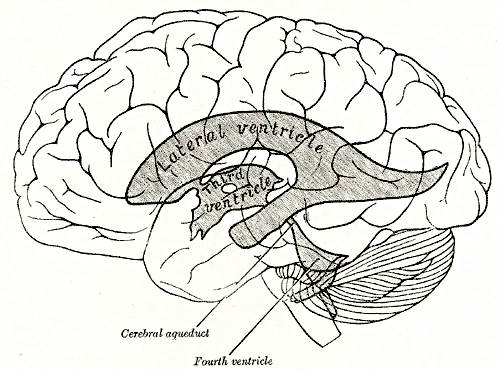 The ventricles drawn into the side of the brain: lateral ventricle, third ventricle, cerebral aqueduct and fourth ventricle, Gray's Anatomy, 20th edition, 1918, figure 734Wikimedia Commons, Henry Vandyke Carter, Public domain (Gray734.png)
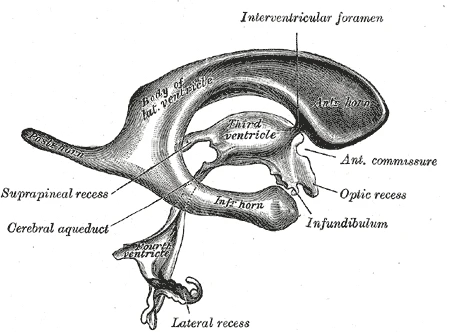 A cast of the ventricles seen from the side, after Retzius, Gray's Anatomy, 20th edition, 1918, figure 736Wikimedia Commons, Henry Vandyke Carter, Public domain (Gray736.png)
This cerebrospinal fluid is clear and almost free of cells. About 500 millilitres form each day, most of it from the choroid plexus, tufts of capillaries in the ventricles. The system holds about 150 millilitres, so the fluid is replaced three to four times a day. The brain floats in it, which spares its base from its own weight.
Sources
- Susan Standring (ed.), Gray's Anatomy, 42nd ed. (2020), chapter on the meninges and ventricular system.
- Arthur Guyton and John Hall, Textbook of Medical Physiology, 13th ed. (2016), ch. 62.
Prev: MemoryNext: The brainstem