A vertebra
A typical vertebra, such as this third lumbar vertebra, has two parts. In front is the body, a short drum of spongy bone that carries the weight. Behind it the vertebral arch encloses the vertebral foramen. Stacked, the foramina form the canal for the spinal cord and, in the lower back, the bundle of nerve roots called the cauda equina.
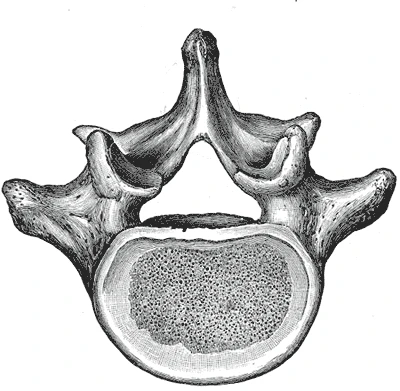 A lumbar vertebra from above, with the body in front and the arch and its processes behind, Gray's Anatomy, 1918, figure 94Wikimedia Commons, Henry Vandyke Carter, Public domain (Gray94.png)
Seven processes stand out from the arch. The spinous process points back, and is the bump you feel down the middle of the back. Two transverse processes point to the sides, and muscles and ligaments pull on all three. Four articular processes form small joints with the vertebrae above and below.
Vertebrae differ by region. A cervical vertebra is small and has a hole in each transverse process for an artery to the brain. A thoracic vertebra carries joint surfaces for the ribs. Lumbar vertebrae have the largest bodies.
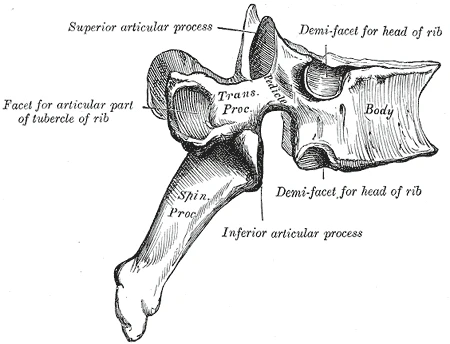 A thoracic vertebra from the side, with the facets for the head and the tubercle of a rib, Gray's Anatomy, 1918, figure 90Wikimedia Commons, Henry Vandyke Carter, Public domain (Gray90.png)
Sources
- Susan Standring (ed.), Gray's Anatomy, 42nd ed. (2020), chapter on the back.
Prev: Four curvesNext: The discs