Cells that build and remove bone
Compact bone is built of osteons, columns about a fifth of a millimetre across that run along the shaft of a bone such as the tibia. Each osteon is a set of rings of bone around a central canal for blood vessels and nerves. Between the rings live osteocytes, bone cells that stay in touch through fine channels.
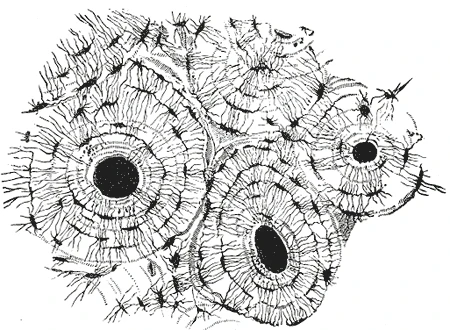 Compact bone cut across and magnified: osteons, each a set of rings around a central canal, with the spaces of the bone cells between the rings, Gray's Anatomy, 1918, figure 73Wikimedia Commons, Henry Vandyke Carter, Public domain (Gray73.png)
Osteoblasts lay down new bone and osteoclasts, large cells with many nuclei, dissolve it. Working together, they rebuild the skeleton all through life, replacing about a tenth of an adult's bone each year. Loading makes bones thicker. Weeks of bed rest or weightlessness thin them.
Bone is also the body's calcium store. It holds about 99 percent of the body's calcium, about 1 kg in an adult. When the calcium in the blood falls, parathyroid hormone makes osteoclasts release some from bone.
Sources
- Susan Standring (ed.), Gray's Anatomy, 42nd ed. (2020), chapter on bone and cartilage.
- Arthur Guyton and John Hall, Textbook of Medical Physiology, 13th ed. (2016), ch. 80.
Prev: Compact and spongy boneNext: Marrow