Compact and spongy bone
Each bone has a dense outer shell of compact bone. Inside, especially at the ends, lies spongy bone, a lattice of thin struts and plates called trabeculae. In a long bone such as the femur, the shaft is a tube of compact bone around a cavity that holds marrow. About four fifths of the skeleton's weight is compact bone.
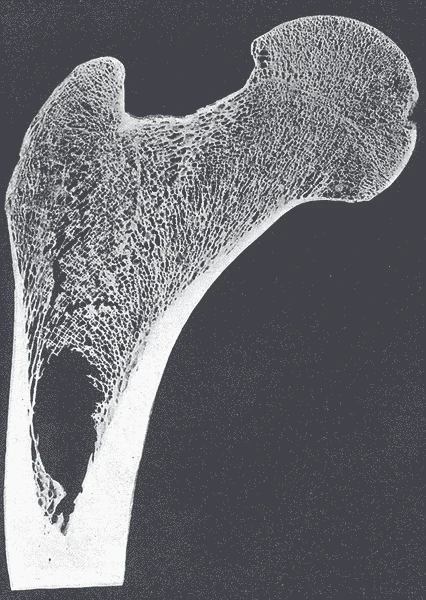 The upper end of a femur sawn lengthwise: spongy bone fills the head and neck, and a shell of compact bone runs down the shaft, Gray's Anatomy, 1918, figure 247Wikimedia Commons, Henry Vandyke Carter, Public domain (Gray247.png)
The trabeculae line up along the forces a bone carries. In the head and neck of the femur they run in arches, like the struts of a crane, so the bone is strong where it needs to be and light elsewhere.
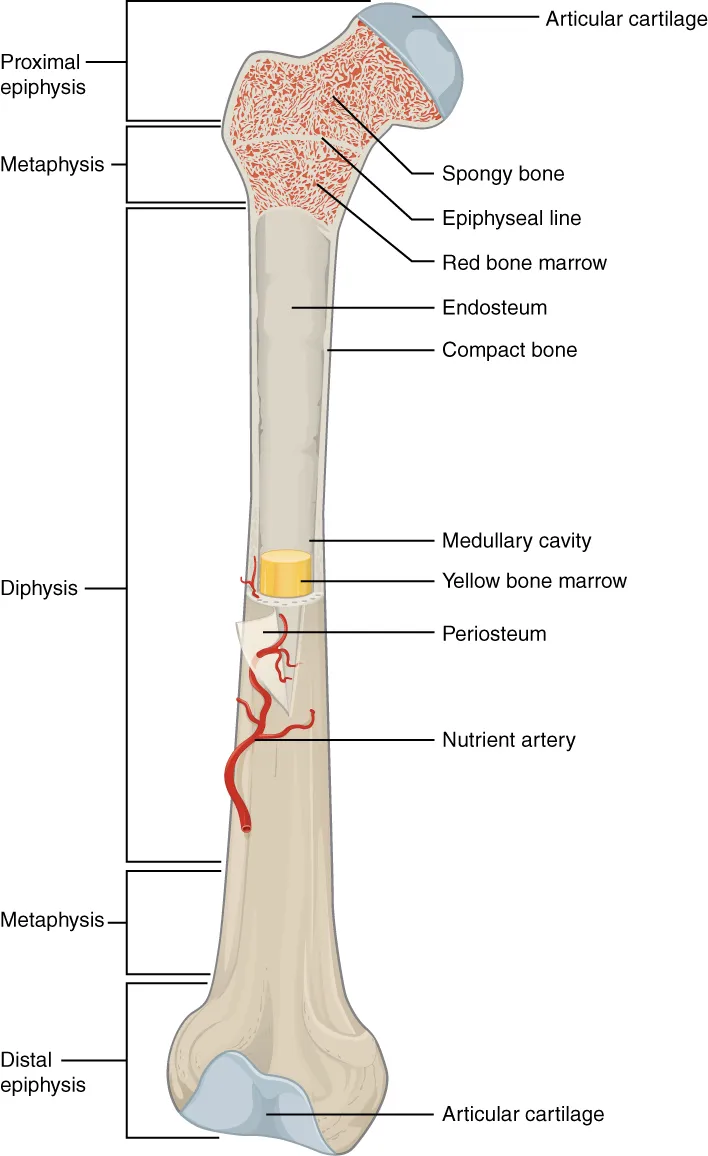 The parts of a long bone: a shaft of compact bone around the marrow cavity, and spongy bone with red marrow in the endsWikimedia Commons, OpenStax College, CC BY 3.0 (603 Anatomy of Long Bone.jpg)
By weight, bone is about 60 percent mineral, crystals of calcium phosphate, and the rest mostly collagen fibres and water. The mineral makes it hard. The collagen lets it bend a little without snapping.
Sources
- Susan Standring (ed.), Gray's Anatomy, 42nd ed. (2020), chapter on bone and cartilage.
- Arthur Guyton and John Hall, Textbook of Medical Physiology, 13th ed. (2016), ch. 80.
Prev: Long, short, flat and irregularNext: Cells that build and remove bone