The discs
Between the bodies of the vertebrae, from the second cervical down to the sacrum, lie 23 intervertebral discs. Together they make up about a quarter of the length of the column above the sacrum. They let the vertebrae tilt and turn on each other and spread the load. Here the lumbar vertebrae and their discs are cut down the middle.
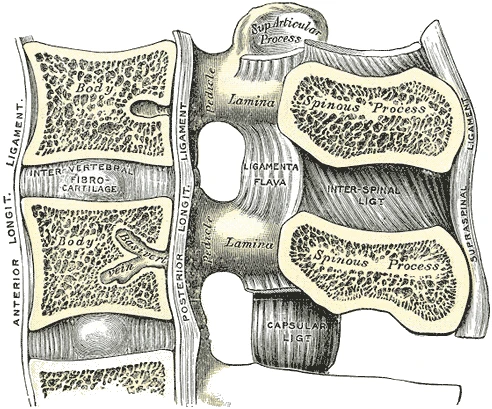 Two lumbar vertebrae cut down the middle, with the disc between their bodies and the ligaments of the column, Gray's Anatomy, 1918, figure 301Wikimedia Commons, Henry Vandyke Carter, Public domain (Gray301.png)
Each disc has a tough outer ring, the annulus fibrosus, made of layers of fibrous cartilage whose fibres cross from one layer to the next. Inside lies the nucleus pulposus, a soft gel that is mostly water. Under load the nucleus presses outward and the ring holds it in.
Through the day the load squeezes water out of the discs, and lying down at night they take it back. An adult is about 1 to 2 cm taller in the morning than in the evening.
Sources
- Susan Standring (ed.), Gray's Anatomy, 42nd ed. (2020), chapter on the back.
- Thomas Reilly, Andrew Tyrrell and John Troup, Circadian variation in human stature, Chronobiology International 1 (1984): 121 to 126.
Prev: A vertebraNext: A slipped disc