A newborn's soft spots
At birth the bones of the skull roof have not yet joined. Between them lie fontanelles, patches of membrane that can be felt as soft spots. The largest, the anterior fontanelle, is a diamond between the frontal bone and the two parietal bones. The posterior fontanelle lies between the parietal bones and the occipital bone.
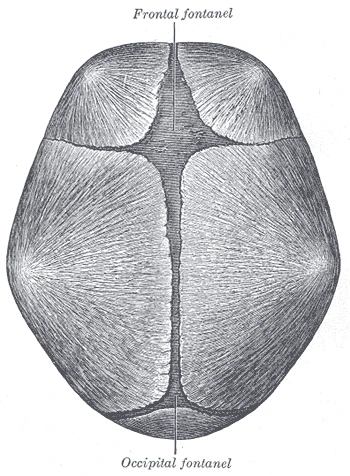 A newborn's skull from above, with the anterior (frontal) and posterior (occipital) fontanelles, Gray's Anatomy, 1918, figure 197Wikimedia Commons, Henry Vandyke Carter, Public domain (Gray197.png)
The loose plates can slide over each other, so the head narrows a little as it passes through the birth canal. They also leave room for the brain, which more than doubles in weight in the first year.
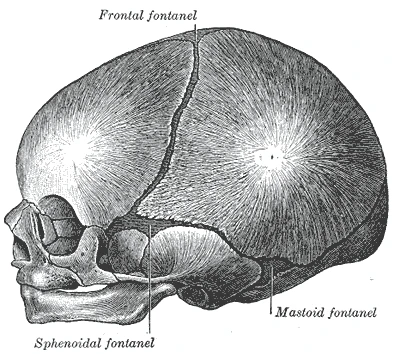 A newborn's skull from the side, with the smaller sphenoidal and mastoid fontanelles, Gray's Anatomy, 1918, figure 198Wikimedia Commons, Henry Vandyke Carter, Public domain (Gray198.png)
Smaller fontanelles lie at the sides of the skull. The posterior fontanelle closes within two or three months of birth. The anterior one usually closes during the second year.
Sources
- Susan Standring (ed.), Gray's Anatomy, 42nd ed. (2020), chapters on the skull and on the development of the head.
Prev: SuturesNext: The jaw